
Building the product turns out to be the easier half for a lot of European founders, and I say that having watched a fair few of them find it out the hard way. The other half is finding enough money, round after round, to keep the company growing while it is still losing money, and that half is where the good ideas quietly run out of road.
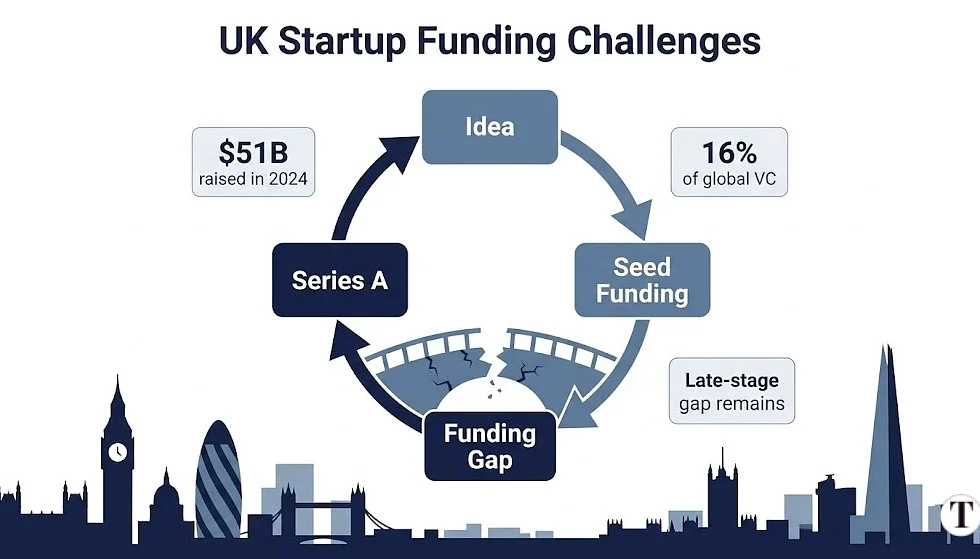
The numbers behind that are not vague. Crunchbase had European startups raising about $51 billion in 2024, which was around 16% of everything venture capital put into the world that year, and UK companies took about a third of it, somewhere near $17 billion.
That was still less than half of what Europe raised in 2021, when the total hit $117 billion and everyone assumed it would keep going. It did not. What has happened since is more interesting than the slump: Crunchbase put Europe at $24 billion in the second quarter of 2026 alone, the biggest quarter in 4 years, and UK startups took $10.4 billion of it, so the money has come back, only now it is going to fewer companies in bigger cheques.
Getting the first cheque has never been the hard part in this country. The late stage is where the gap opens, because once a company needs £20 million or £50 million rather than £2 million, the number of funds in Britain that can write it drops away, and a founder who cannot find that money here starts looking at Boston or New York, and sometimes moves the whole company there.
So this piece goes through the problems UK founders run into when they raise, then what helps with each of them, and near the end where AI-built pitch decks fit into all of it, because they do now, whether the old guard likes it or not.
Analyst Insights: What Is Driving UK Capital Raising
Statista’s market read on UK capital raising, in plain words:
- The traditional side of the market has dipped a little, and the reasons are the ones you would guess, uncertain economy, cautious investors, rounds taking longer to close.
- Where the money is moving is towards sustainability and ethics, the ESG side (environmental, social, governance), and it is younger investors pushing that, choosing what matches what they believe.
- Impact investing keeps growing with it, so a business that can show what good it does is finding investors easier to reach than one that cannot.
- The regulation helps here rather than hurts. The Financial Conduct Authority (FCA) leans on companies to disclose their ESG practices, that transparency builds confidence, and London has turned into a real centre for green finance because of it.
- Underneath all of that the usual things still set the temperature, interest rates, GDP, unemployment, investor mood, and the government’s tax breaks on sustainable investment add a little pull of their own.
Challenges UK Entrepreneurs And Startups Face In Raising Capital
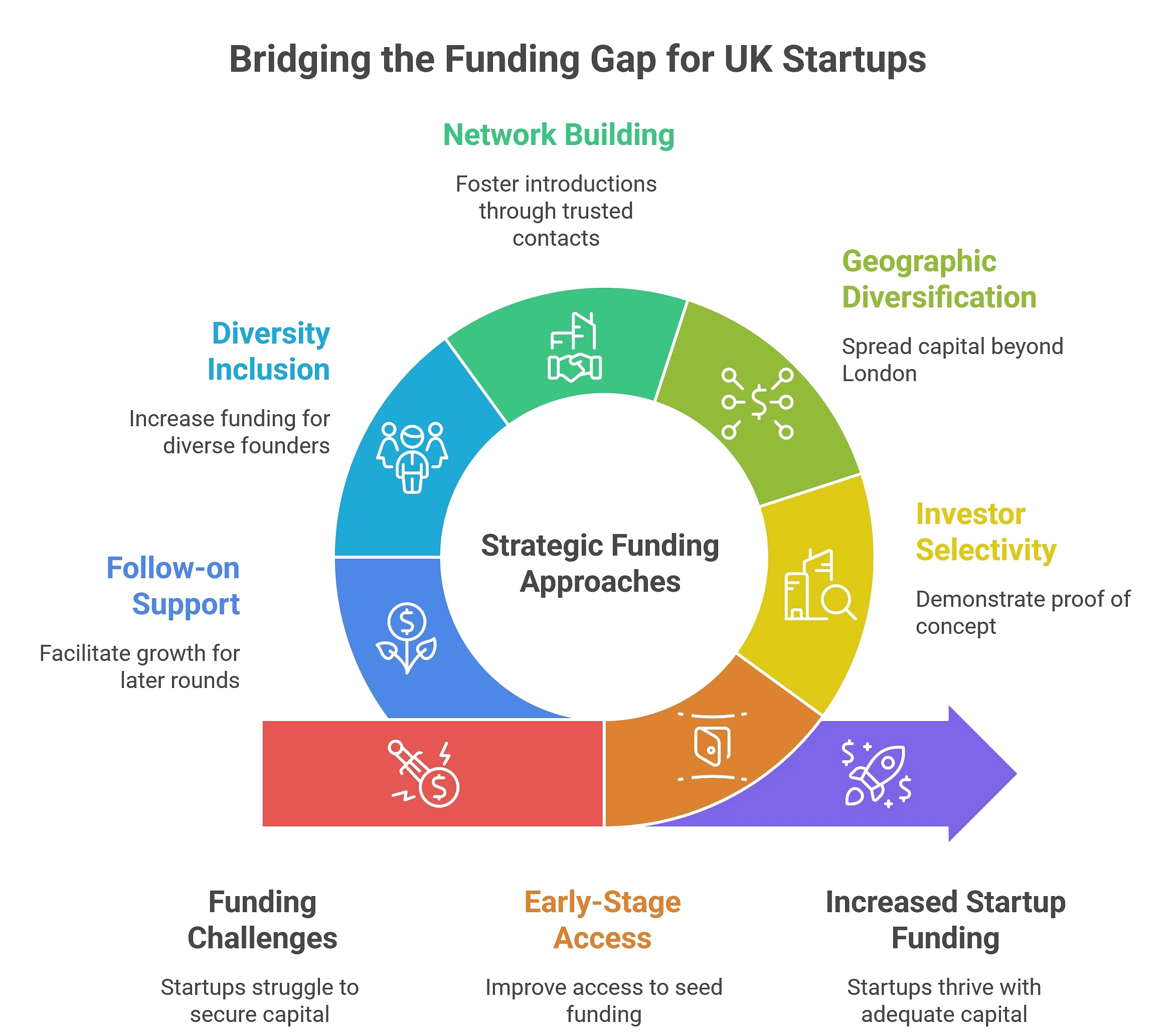
Limited Access To Capital, Especially Early-Stage
The first cheque is the hardest one for most UK founders, and the reason is simple enough: at that stage you have almost nothing an investor can check. No proven product, no revenue, no market validation, just a plan and the people in the room. An investor looking at that sees risk and not much else, and the ones who do write early cheques are pricing that risk into the equity they take.
Increasing Investor Selectivity
UK investors have become a lot more careful, and the uncertain economy has made them more careful still. A venture firm that would have backed a promising team in 2021 now wants to see proof of concept, some early revenue and traction it can measure before it commits, which means the money has pooled around a smaller set of companies that already look like winners. Fine for the investors, who carry less risk. Not fine for the early-stage business with a good idea and no numbers yet, and I think the UK is losing a fair number of those without anyone noticing, because a company that never raised does not show up in any statistics.
The Funding Gap Against Global Competitors
Put a UK startup next to an American one at the same stage and the American one has usually raised more, sometimes several times more, which means it can hire faster, spend more on the product and get to market first. That is the gap in one sentence. It is why so many UK founders end up thinking about a move to the US, and it is why over time the country loses not just companies but the people who built them.
Geographic Inequality, The London Problem
Most UK venture money lands in London and the South East, well over half of it by deal value in most years, and the reason is not that the ideas are better there. The investors are there, the accelerators are there, the lawyers and the introductions are there. A founder in Dundee or Stoke with as good a business will find it harder to get a meeting, let alone a term sheet, and the distance is measured in relationships rather than miles.
Network And Relationship Barriers
Which brings me to what founders learn quickly and hate: a good idea does not get you in the door, an introduction does. Most investors take meetings through people they already trust, and a founder without that network can send 50 cold emails and hear nothing, whereas one warm intro gets a coffee. First-time founders and people from underrepresented backgrounds carry the worst of this, because the network is exactly what they do not have yet.
Regulatory And Structural Complexity
There is more paperwork in a UK raise than a first-time founder expects. Equity deals have to be structured, shareholder agreements drafted, Companies House kept up to date, and every hour that goes into that is an hour not going into the product. Do it badly, or cheaply, and it comes back to bite at the next round, when a new investor’s lawyer finds the cap table does not say what the founder thought it said.
Declining Incentives And Economic Pressures
The wider economy has not helped. Higher interest rates, fewer tax breaks than there used to be, and a market that has not fully settled since the pandemic have all made investors more careful with their money, and when a savings account or a gilt pays a decent return with no risk at all, the case for putting money into a company that might not exist in 3 years gets harder to make. Less capital on offer, fewer founders funded.
Diversity And Inclusion Gaps
Female founders and founders from minority backgrounds raise far less than everyone else, and this has been measured. The Rose Review in 2019 found all-female teams getting about 2p of every £1 of UK venture funding. Some of that is unconscious bias, some of it is the network problem from above, and some of it is wider inequality feeding into the room, but the effect is the same: good ideas from a lot of people never get the money to find out if they were right.
Difficulty Securing Follow-On Funding
Raising the first round is the beginning, not the finish, and plenty of founders find the second round harder than the first, because now there are numbers and the numbers are being judged. Investors want fast growth, steady revenue and a clear position in the market before they put more in, and a company that cannot show that quickly enough can find itself with 6 months of runway and no one returning calls. The pressure that creates pushes founders to grow faster than the business is ready for, which is its own way of failing.
Intense Competition And Market Saturation
There are more startups in the UK than there were, and AI has made it easier to launch one, so the same investors are now looking at more pitches than they can read. Good for innovation in the abstract. Harder for any one company, because standing out in a pile of 200 decks a month is now part of the job.
Useful Tips To Raise Capital In The UK
Maintain Strong Governance
UK investors look at governance early, because it tells them how the company gets run day to day and how much risk they are buying into. A proper board where founders, directors and advisers each know what they are for. Decisions written down, meeting notes, approval processes, a shareholder agreement that reflects reality. Companies House filings and tax records in order. Weak governance reads as risk to a UK fund in a way it sometimes does not in the US, and strong governance is one of the few things a pre-revenue company can show that costs nothing but discipline.
Reliable Management Information
Investors are going to build their view of your company from your numbers, so messy or inaccurate numbers do more damage than no numbers. Profit and loss, cash flow and balance sheet, correct, current and consistent month to month. Then the startup metrics on top:
- Customer acquisition cost (CAC).
- Lifetime value (LTV).
- Burn rate.
- Runway, in months, to the day.
A fund that has to reconcile your figures for you has already decided something about you.
Bridge The Gap Between Seed And Series A
The stretch between seed money and a Series A is where UK startups die most often, which is why people call it the valley of death, and crossing it is mostly about buying time without giving the company away. Convertible notes, SAFEs and venture debt all extend the runway without setting a valuation too early. SEIS and EIS bring in angels by cutting their tax bill, and I will come to those. Crowdfunding works for some consumer businesses. None of it is the goal, the goal is being alive with real traction when the bigger round is on the table.
Build Early Traction And Proof Of Concept
No one funds an idea on its own any more, however big. What gets funded is evidence: early sales, users coming back, a pilot with a real customer, a retention curve that goes the right way. Even small proof helps, a paying customer or two, a testimonial with a name on it, because each one takes a little risk off the table.
Develop A Clear And Scalable Business Model
An investor wants to see how you make money now and, more to the point, how that grows. Subscriptions, transactions, services, whichever it is, set it out plainly, show what the margins are and how they hold or improve at 10 times the size. The models that get funded are usually the simple ones, because a model the investor can explain to their partners in 2 sentences is a model they can back.
Use The SEIS And EIS Schemes
These are the UK’s two big tax relief schemes for startup investors and they do a lot of the heavy lifting at the early stage. SEIS is for the very early companies and gives an investor 50% income tax relief on what they put in, with the company able to raise up to £250,000 under it. EIS is for slightly more mature businesses, 30% relief, up to £1 million a year for the investor and £12 million over the company’s life. Set them up properly, with advance assurance from HMRC before you go out to angels, and you have turned a risky investment into a much less risky one from the investor’s side.
Build Investor Relationships Early
A raise is rarely won in the pitch meeting. It is won in the 6 months before it, in the coffees and the update emails where an investor watches the company make progress without being asked for anything. Founders who start those conversations early, before they need the money, are raising from people who already know the team and have seen the traction arrive, and that is a very different conversation from a cold ask with 4 months of runway left.
Create A Clear Pitch And Story
Numbers on their own do not get a deck read to the end. DocSend’s own data on investor reading has the average time spent on a deck at a little over 2 minutes, so the story has to land fast:
- The problem first, and why it matters enough to solve.
- Then the solution, how it works, why it beats what exists, in plain words with the jargon cut.
- Market size, business model, traction and team, each in its place.
- Why it works here and why it can work abroad, since UK investors like to see both.
Around 10 to 15 slides, each one clean enough to be understood without you in the room.
Diversify Funding Sources
One source of money is one point of failure. Most UK startups that get through the early years have mixed angels, venture money, crowdfunding and grants, and that mix does 2 things at once: it spreads the risk, and it tells the next investor that several different kinds of people have already looked and said yes.
Strengthen Your Team And Leadership
Investors are backing people, and they will say so if you ask them. A team that has done it before, or can show it knows how, is worth a lot on a term sheet, and a gap in the team, no one who has sold, no one who has shipped, is something to fix before the raise rather than explain during it. Advisers with the right names help too, for credibility and for the introductions in the section above.
Focus On Capital Efficiency
The market has swung towards companies that spend carefully. Keep the burn rate under control, spend on what moves growth and not on what looks like growth, and be able to show it. A company that has done a lot with a little is one an investor trusts to do more with more.
Prepare Due Diligence Materials Early
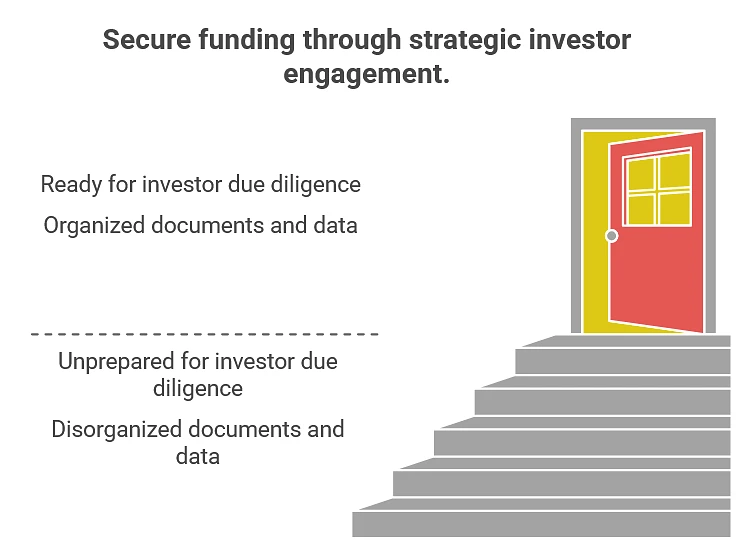
Due diligence is where deals slow down and sometimes die, and almost always for a boring reason: a document that could not be found. Financials, legal agreements, IP records, customer contracts, all filed and current before the process starts. The companies that have that ready close faster and look better doing it, and the ones that do not spend 3 weeks looking for a signed contract while the investor’s interest cools.
Target The Right Investors
Do not send the same deck to every fund in the database, because the funds can tell. Find the ones who invest at your stage and in your sector, read what they have backed, and go to them with something that shows you know why they would care. The right investor brings more than money, they bring the next introduction and the advice from the last company that had your problem, and that is worth being selective for.
Understand Valuation Realistically
Valuation matters, and founders get attached to a number. Base it on what is real, traction, revenue, growth, rather than on what the last hot company in your sector raised at, and be ready to move. A founder who is flexible on valuation closes faster and starts the relationship with an investor who does not feel they overpaid.
Where AI-Powered Presentations Fit For Founders
Hmm, this is the part where I expect a few readers to roll their eyes, and I get it, but AI-built decks are now a normal part of how founders prepare, and in a market as selective as this one they earn their place. Here is where they help.
Investors Expect Data-Rich, Insightful Pitches
UK investors read decks analytically now, and a wall of numbers does not survive that. AI presentation tools take the raw figures and turn them into charts that make sense at a glance, pull out the metrics that matter, growth trend, churn, unit economics, and show projections and scenarios without a designer in the loop. The deck stops being static slides and starts carrying an argument.
Faster Creation Without Sacrificing Quality
A founder is usually building the product, hiring and raising in the same week, and the deck is what gets done at midnight. Tools like Beautiful.ai, SketchBubble AI, Canva and others generate slides from a prompt, handle the layout, and let you spin off a variant for a different investor in minutes rather than an evening, which leaves the founder’s time for what they are going to say rather than where the logo goes.
Personalisation For Different Investors
A venture fund, an angel and a corporate investor are looking for different things in the same company, and the deck should shift with them. AI slide tools make that cheap: a version that leads on sector metrics for the specialist fund, a version that leads on the team for the angel, the storytelling adjusted to what each one cares about. A pitch that speaks to the person in front of you lands better than a general one, and now it costs almost nothing to make 3 of them.
Stronger Storytelling Through AI Assistance
The story is what wins the room, and a lot of founders are better at building than telling. AI presentation generators help structure the argument so it runs in a logical order, sharpen the messaging, and cut the jargon that creeps in when someone has been inside their own product for 2 years. Complicated ideas come out easier to follow.
Better Visual Communication
Investors see dozens of decks a week, and the ones with clear visuals get read properly. AI improves the charts and infographics, keeps the branding consistent slide to slide, and gives a professional finish without an agency invoice. A well-designed deck says something about the founder before a word is read.
Cost Efficiency For Early-Stage Startups
Designers and pitch consultants are expensive, and at the pre-seed stage that money has better uses. AI tools give high-quality output for very little and cut the dependence on outside help, which matters most to exactly the founders who have the least.
Standing Out
With this many UK startups chasing the same funds, the quality of the presentation is part of how a company gets noticed. A clear, well-built deck stands out from the pile, shows the founder uses modern tools well, and reads as efficiency and adaptability before the investor has met the team. What you say still matters most. How you say it decides whether it gets heard.
Where That Leaves A Founder
Raising in the UK comes down to trust, a clear plan and good positioning. Strong governance, clean numbers and a way across the seed-to-Series-A gap get you to the table. Real traction, careful spending and relationships built before you needed them get you the cheque. Picking the right investors for your stage and sector saves you months.
AI-built decks help with the telling, they save time and make the case easier to follow, and they do not replace any of the above. Investors still look at traction, market size, team and model first, and a good deck only gets those things in front of them.