
Artificial intelligence does not merely improve the efficiency of the stock forecasting industry; instead, it has completely restructured the underlying logic of this field. A full-dimensional market analysis that originally required several weeks to complete can now output results in only a few minutes.
These systems are great at surfacing short-term signals, spotting correlations, and helping with risk management when markets turn choppy. What they can’t do is remove uncertainty, especially over longer time horizons where surprises and regime shifts overwhelm any neat pattern. The smartest way to use AI is as decision support: it nudges probabilities, not promises. That starts with understanding what AI can, and can’t, predict.
What AI Can and Cannot Predict in Stocks
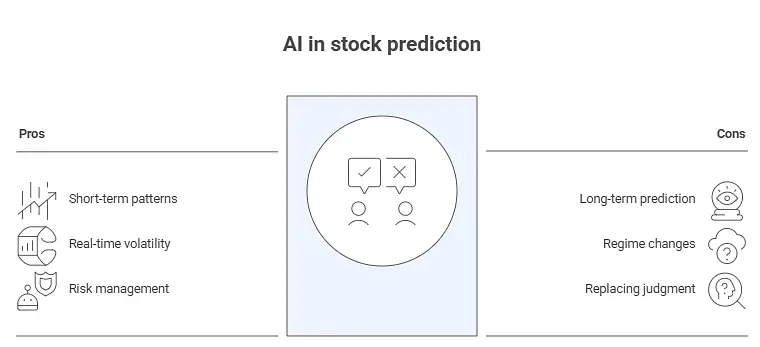
AI improves pattern detection and processing speed, but it does not deliver certainty. Predictive models are genuinely useful for short-term signal finding, where they can surface correlations and anomalies faster than any manual process. For longer time horizons, however, confidence should drop proportionally, because the variables shaping markets multiply in ways that even the most sophisticated systems cannot fully account for.
The practical framing here is probabilistic. AI outputs represent likelihoods, not outcomes, and treating them as anything more creates the kind of overconfidence that leads to poor risk management. Used correctly, these tools function as decision support for investment decisions, helping investors structure their thinking rather than replacing it.
Where AI adds clear value:
- Detecting short-term price patterns and momentum signals
- Processing market volatility indicators across large datasets in real time
- Supporting risk management through scenario modeling and exposure monitoring
Where confidence should stop:
- Reliable long-term stock market prediction
- Anticipating regime changes, geopolitical shocks, or structural market shifts
- Replacing judgment with certainty
How AI Stock Forecasting Actually Works
Model quality in AI stock forecasting varies considerably depending on data inputs, time horizon, and use case. Retail investors increasingly encounter these tools through platform rankings and comparisons, and according to WallStreetZen, the market already distinguishes meaningfully among different predictor tools based on how they are built and what they are designed to do. Understanding the mechanics behind these systems helps explain why some perform better than others in specific contexts.
The Data Layer Behind the Models
AI forecasting systems are only as useful as the data feeding them. Most draw from a combination of historical price data, trading volume, and technical indicators as their foundation, then layer in additional signals to refine their outputs.
Beyond the numbers, many systems now pull in unstructured text. Through natural language processing and sentiment analysis, models can process earnings call transcripts, financial news, and social media activity, converting language into quantifiable signals. This is where AI’s expanding presence across industries becomes apparent: the same text-processing techniques reshaping law and healthcare are being applied to financial data at scale.
Alternative data, including satellite imagery, web traffic patterns, and supply chain indicators, has also become part of more advanced forecasting pipelines, giving models access to information that traditional analysis never considered.
The Models Most Often Used
Once the data is assembled, the model architecture determines how patterns are extracted and interpreted. Neural networks form the backbone of most modern approaches, designed to detect non-linear relationships that simpler statistical tools would miss.
The mainstream core basic neural network can capture nonlinear relationships overlooked by simple statistical tools; multi-layer stacked deep learning can process high-complexity datasets containing multiple interacting variables; LSTM, the most widely used architecture in financial scenarios, is a specialized sub-architecture of deep learning that can retain time-series information to adapt
Traditional tools such as moving averages now only function as input features rather than core prediction engines. The most efficient predictors must combine classic indicators and machine
Why AI Changed Market Forecasting So Quickly
The speed of AI adoption in financial markets was not accidental. Traditional analysis required analysts to review data sequentially, which created natural limits on how many variables any team could monitor at once. AI systems removed that ceiling entirely, processing large datasets in real time across thousands of securities simultaneously.
That capacity for parallel processing is what made algorithmic trading and high-frequency trading viable at their current scale. Firms can now operationalize forecasts within milliseconds, executing investment decisions before a human analyst has finished reading the opening line of a report. Research published by the SEC documents how high-frequency trading strategies transformed market microstructure precisely because speed became a competitive advantage.
Institutional players moved quickly to build on this foundation. BlackRock Aladdin, the risk management platform used across trillions in assets, continuously scans macro indicators, portfolio exposures, and market signals that no manual process could track at equivalent depth. Renaissance Technologies, whose Medallion Fund is among the most studied in quantitative finance, built its edge on finding statistical patterns across datasets that traditional analysis would never have examined.
What changed was not just analytical power, but the scope of what counts as relevant information. The same AI-powered tools reshaping workflows across industries are applied in trading systems to monitor variables ranging from order flow imbalances to macroeconomic text feeds, all feeding into models that update continuously.
Where AI Forecasting Breaks Down
The benefits described above come with real limitations, and understanding those limitations is just as important as recognizing the capabilities. AI forecasting systems can fail in ways that are not always obvious, and some of those failure modes carry significant financial consequences.
Why Backtests Can Mislead Investors
One of the most popular methods for assessing an AI model prior to deployment is backtesting, but it is also one of the most deceptive. Because the model has been adjusted, whether on purpose or not, to the patterns previously found in the past price data, it may appear to be very accurate.
It’s overfitting. The model learns the noise in addition to the signal, yielding results that appear robust during testing but drastically worsen when used in real-world markets. The issue is exacerbated by regime shifts: when market structure rapidly changes, a model that was trained during a period of low volatility may not hold because the statistical associations it learnt are no longer relevant.
Another level of danger is introduced by data bias. The model’s apparent performance more closely reflects the dataset than any true predictive advantage if the training set over-represents particular periods or excludes certain market situations. Model drift, in which accuracy gradually deteriorates as market dynamics change, sometimes goes unnoticed until losses mount.
When Market Structure Turns Into Risk
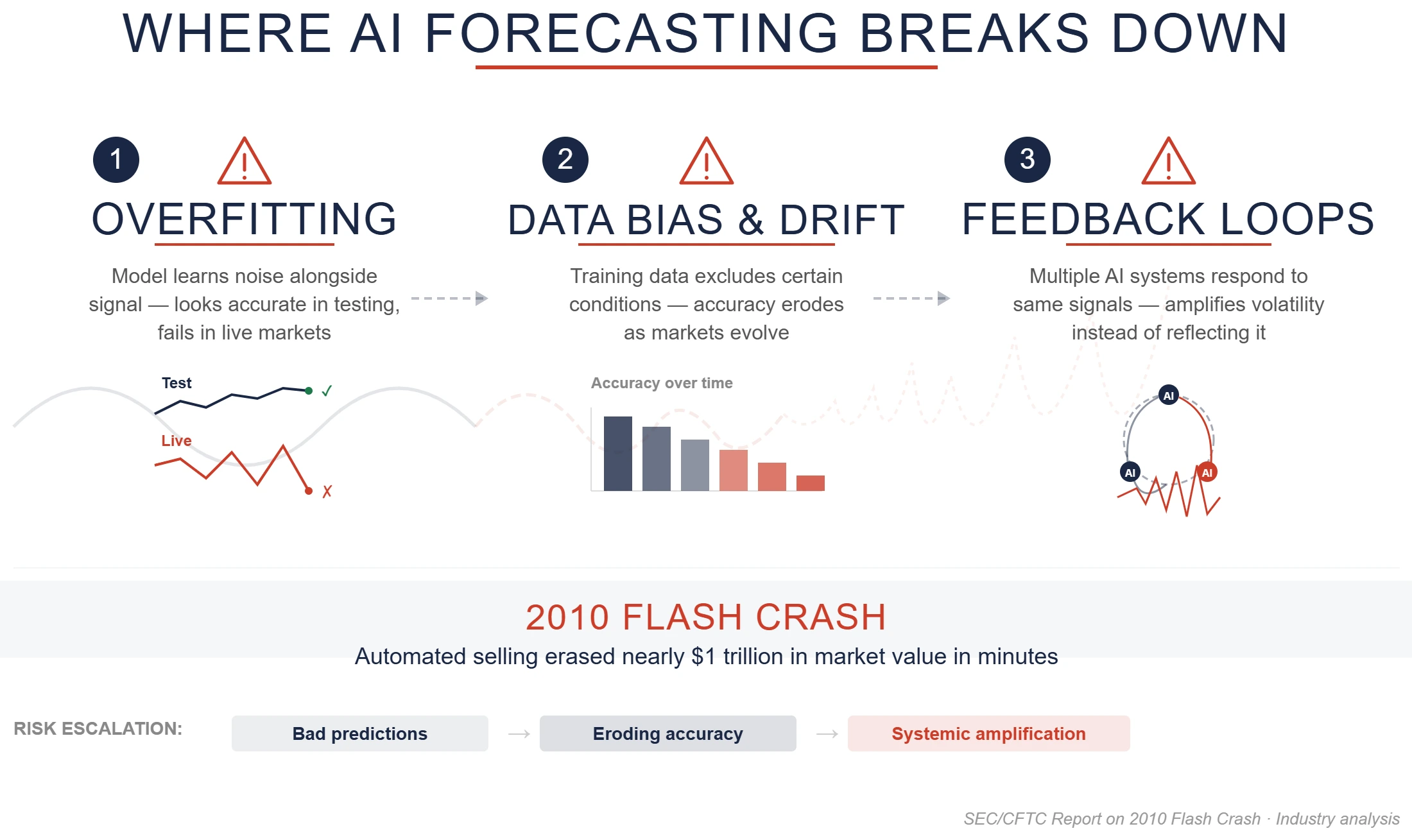
The risks are not limited to individual models. When many algorithmic trading systems respond to the same signals, they can create feedback loops that amplify market volatility rather than reflect it. The 2010 Flash Crash is the most cited example: automated selling cascaded rapidly across markets, erasing nearly a trillion dollars in equity value within minutes before a partial recovery.
Herding behavior among AI-driven strategies remains an ongoing concern for regulators. Both the SEC and FINRA have expanded their oversight of algorithmic trading specifically because correlated model behavior can destabilize markets in ways that no single firm’s risk management can contain.
How Investors Should Use AI Forecasting Tools
The best results from AI forecasting systems come from treating them as multiple inputs rather than as a single signal. More informed investing decisions are made when model results are combined with technical analysis, fundamental research, and a clear understanding of portfolio objectives.
It is very important to match technologies to time horizons. Longer-range macro forecasting systems operate differently from short-term momentum models, and it is incorrect to expect either to perform well outside of its design range. Investors who comprehend the purpose of a particular tool are in a much better position to analyse its real results.
Practical discipline around risk management should accompany any use of AI outputs:
- Size positions relative to the uncertainty embedded in any forecast, not its apparent confidence level.
- Run scenario planning across multiple possible outcomes rather than anchoring to a single prediction.
- Treat any system making high-certainty stock market prediction claims with proportional skepticism.
Black-box certainty is a red flag regardless of how sophisticated the underlying model appears. No system eliminates market unpredictability, and those presenting outputs as near-guaranteed outcomes are obscuring the limitations that every honest practitioner in the field acknowledges. The most disciplined approach treats AI as a tool that sharpens judgment, not one that replaces it.