

Most in-house lawyers didn’t train to become project managers. But that’s essentially what’s happened. Somewhere between the third SaaS renewal of the month and a procurement request that came in with half the information missing, the job stopped being about legal analysis and started being about throughput. And nobody really talks about that shift — not properly, anyway.
There’s a common assumption floating around boardrooms that if the legal team is struggling, it must be because the contracts are too complicated. Bring in more senior people. Get external counsel involved. Maybe the clauses need simplifying.
That’s the wrong diagnosis. For most enterprise legal functions in the UK right now, complexity isn’t the bottleneck. Volume is.
The Numbers Behind the Noise
The ONS reported 2.73 million VAT and/or PAYE-registered businesses operating in the UK as of March 2025 — up 0.4% on the year before. Companies and public corporations now make up 76.7% of all UK businesses. That’s a lot of entities entering into commercial agreements with each other, every single day.
And the global contract lifecycle management market? Valued at roughly $1.4 billion in 2025, projected to hit $4.1 billion by 2034. That growth isn’t happening because contracts got harder to read. It’s happening because there are more of them. Significantly more.
A mid-market UK firm processing 1,000 contracts a year isn’t unusual anymore. NDAs, data processing addendums, statements of work, SaaS subscriptions, vendor onboarding agreements, variations, amendments — they pile up. Each one individually manageable. Together, they’re an operational headache that legal teams weren’t structured to absorb.
Where It Actually Breaks Down

Legal Futures reported a ContractWorks survey finding that nearly half of in-house lawyers said their organisations were missing automatic contract renewals — at an average cost of almost £30,000 per missed contract. One respondent mentioned accidentally renewing a contract worth £250,000 that nobody wanted.
Fifteen per cent of those surveyed said they used Post-it notes to track renewal dates. Twelve per cent wrote reminders on their hands.
That’s not a joke. That’s a snapshot of how real legal departments actually operate when volume overwhelms systems. And 71% of those lawyers said their business didn’t focus enough on managing contracts after signature. The work doesn’t stop once someone signs — but the attention does.
The Invisible Labour Problem
Here’s something that doesn’t show up in any KPI dashboard: the amount of time in-house lawyers spend doing work that isn’t legal work.
Chasing procurement for a missing schedule. Confirming whether a variation was actually executed or just discussed. Explaining the same position to three different stakeholders because the context is buried in a thread from six weeks ago. Locating the latest version of an agreement across shared drives, email attachments, and someone’s desktop folder.
None of that is legal analysis. All of it consumes capacity. And as contract numbers climb, this invisible load grows faster than the substantive work. A five-minute intake delay becomes hours across a week. A clause tracker nobody updates becomes a blind spot across hundreds of agreements.
The irony is that the lawyers are perfectly capable. The systems around them aren’t.
What UK Law Actually Says About Getting This Wrong
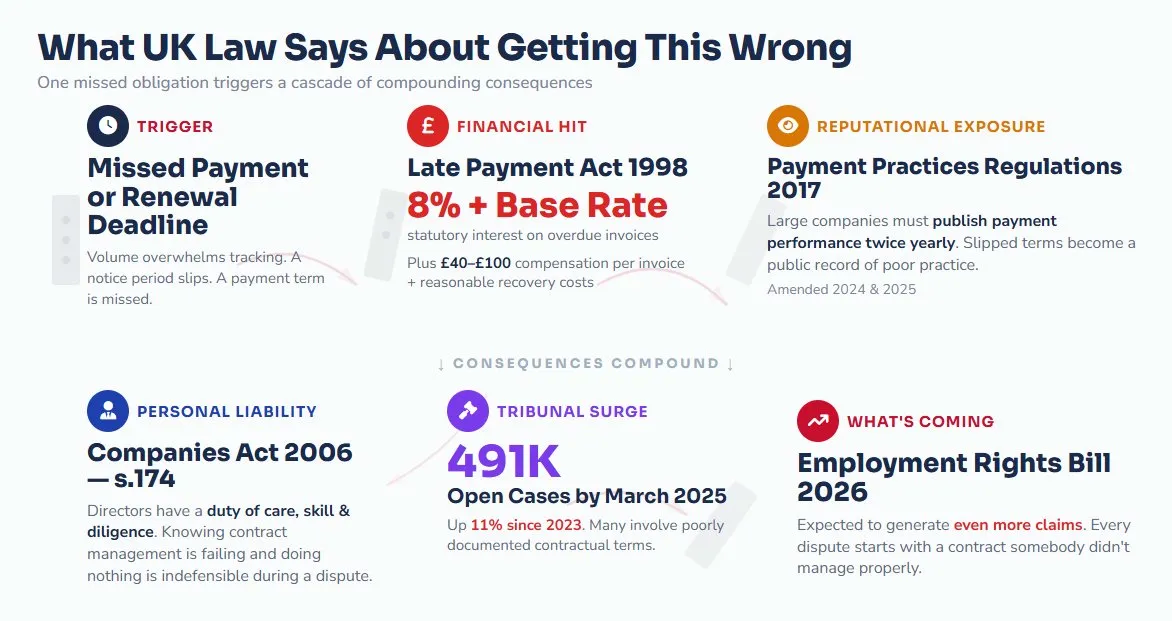
Missing a contractual obligation isn’t just embarrassing — it can be expensive in ways that compound.
The Late Payment of Commercial Debts (Interest) Act 1998 gives any UK business the statutory right to charge interest at 8% above the Bank of England base rate on overdue invoices. On top of that, compensation ranges from £40 to £100 per invoice depending on the debt size, plus reasonable recovery costs. Since the Reporting on Payment Practices and Performance Regulations 2017 (amended in 2024 and again in 2025), large UK companies are required to publish their payment practices and performance twice yearly — including how long they take to pay invoices.
If your legal team is so buried in volume that payment terms slip, notice periods get missed, or obligations aren’t tracked post-signature, you’re not just losing money on individual contracts. You’re creating a public record of poor practice.
Then there’s the Companies Act 2006 obligations around directors’ duties — specifically s.174, the duty of care, skill, and diligence. If a director knows the company’s contract management is inadequate and does nothing about it, that’s not a great position to be in during a dispute.
Employment tribunal receipts hit 491,000 open cases by March 2025, up 11% since 2023. Many of these involve contractual disputes around terms of employment, variations, or monitoring arrangements that weren’t properly documented. The Employment Rights Bill 2026 is expected to generate even more claims. Every one of those disputes starts with a contract somebody didn’t manage properly.
Why Hiring Doesn’t Fix a Structural Problem
The instinctive response when legal falls behind is to add headcount. It makes sense on paper. In practice, it barely helps.
New lawyers still rely on the same fragmented systems — the shared drives, the email chains, the manual trackers that were already failing before they arrived. They add coordination overhead. Knowledge doesn’t transfer neatly when institutional memory lives in individual inboxes. And frankly, good in-house lawyers in the UK aren’t cheap to hire. A mid-level commercial lawyer in London costs upwards of £70,000 before you factor in recruitment fees, benefits, and the three months before they’re fully operational.
What you’ve done is layer more people onto a broken process. Volume is a structural problem. You can’t solve it with more humans doing the same manual steps.
Only 55% of corporate legal teams currently use any form of contract lifecycle management. That means nearly half are still relying on some combination of spreadsheets, Outlook folders, and institutional knowledge that walks out the door every time someone leaves. For organisations dealing with high contract throughput, adopting contract management software isn’t about replacing legal judgement — it’s about giving legal teams the infrastructure to actually do their jobs at the scale the business now requires.
The Real Risk Isn’t Bad Drafting — It’s Poor Tracking
This is worth saying plainly: most enterprise contracts in the UK aren’t badly drafted. Templates exist. Playbooks exist. Clause libraries get maintained. The legal quality of the individual document isn’t usually the problem.
The problem is what happens after signature.
Obligations get buried. Auto-renewal dates pass without review. Non-standard terms that got conceded during a rushed negotiation sit unmonitored across hundreds of active agreements. Variations are agreed verbally and never formalised. Payment schedules drift.
Risk doesn’t increase because the contracts are weak. It increases because nobody has line of sight across the portfolio. Volume creates noise, and the signals that matter — the renewal that needs cancelling, the SLA that’s been breached, the payment term that triggers a penalty — disappear into it.
Treating It as an Operations Problem, Not a Legal One
The legal teams that manage volume best don’t treat it as a legal challenge. They treat it as an operational one.
That means structured intake. It means standardised pathways for low-risk, high-frequency agreements. It means reducing unnecessary touchpoints — not every NDA needs a partner’s eyes on it. It means visibility across the lifecycle, so someone can look at a dashboard and know where every contract sits without opening an email.
This isn’t about making lawyers less involved. It’s about making sure they’re involved in the right things. An experienced commercial lawyer reviewing a boilerplate NDA for the forty-seventh time this quarter isn’t adding value. That same lawyer spending their time on a complex joint venture agreement or a high-risk supply chain contract absolutely is.
The UK government’s own £144.3 million Matrix Programme for technology and systems integration services reflects how seriously even the public sector is taking this. Back-office contract management isn’t glamorous, but it’s being funded because the cost of getting it wrong is worse.
What Actually Changes Things
No single fix resolves the volume problem. But the organisations that do handle it tend to share a few things in common.
They’ve got clear ownership — every contract has someone accountable for its lifecycle, not just its execution. They’ve reduced handoffs between teams, because every handoff is a point where information degrades. They’ve built transparency into the workflow, so legal, procurement, finance, and the business units can see what stage a contract is at without anyone having to ask.
And they’ve accepted that the old methods don’t scale. Shared drives and spreadsheets worked when the business signed 200 contracts a year. They don’t work at 2,000. Pretending otherwise just means more Post-it notes and more £250,000 mistakes.
The breaking point for in-house legal isn’t when contracts get too hard. It’s when the work never stops, the context keeps shifting, and the infrastructure never catches up. That’s not a legal problem. It’s an organisational one. And until it’s treated that way, the same people will keep carrying a load that expertise alone was never designed to absorb.
References
- Office for National Statistics — UK Business: Activity, Size and Location 2025
- Business Population Estimates for the UK and Regions 2025 (GOV.UK)
- Custom Market Insights — Contract Lifecycle Management (CLM) Market Size Report 2025–2034
- Mordor Intelligence — Contract Lifecycle Management Software Market Report 2030
- Legal Futures — “Half of in-house lawyers say companies miss contract renewals” (ContractWorks survey)
- Late Payment of Commercial Debts (Interest) Act 1998
- Reporting on Payment Practices and Performance Regulations 2017 (as amended 2024, 2025)
- Companies Act 2006, s.174
- Moore Barlow LLP — Employment Tribunal Backlogs (Tribunal Statistics Quarterly, January to March 2025)
- Department for Science, Innovation & Technology — Matrix Programme