
There’s an old saying —
A fool and his gold are soon parted.
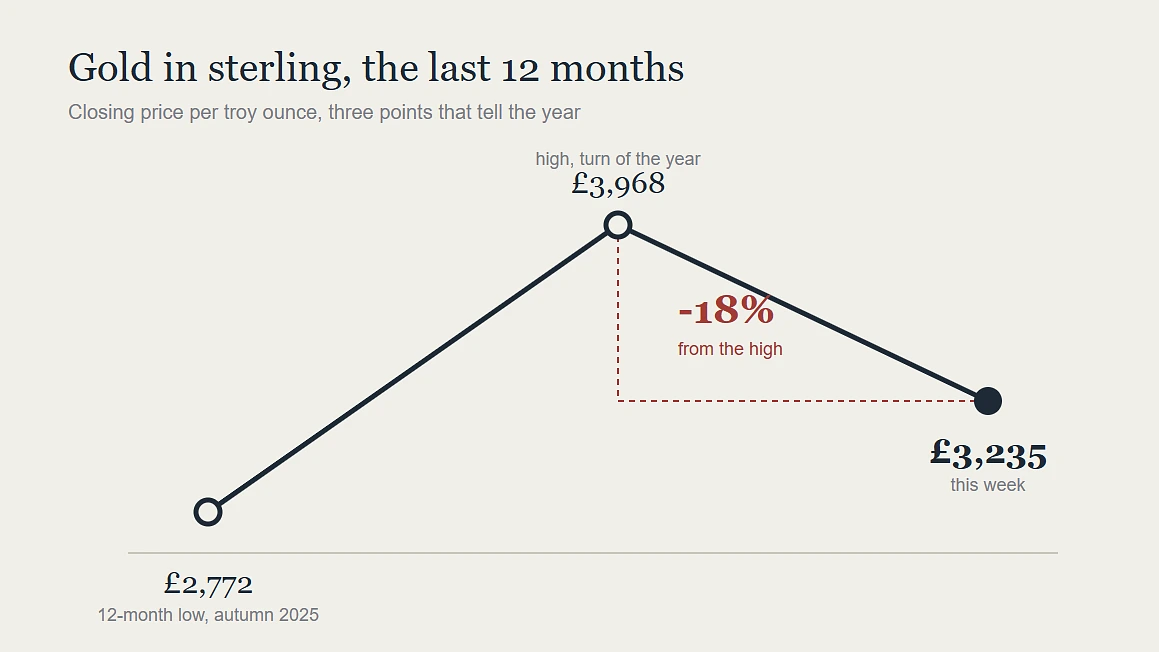
Gold has come off the boil. An ounce in sterling closed above £3,968 at the turn of the year, and this week it sits around £3,235, which is 18% down from that high and more or less where it was 12 months ago. Anyone who bought in 2022 or 2023, when the same ounce cost £1,500 to £1,600, is still sitting on a gain of well over 100%, and a fair number of them are now asking whether to take it before the price slides further. That question has a tax attached to it that did not used to matter much, and now it does.
The run that got everyone here was the 2025 one. In sterling the price went from about £2,097 an ounce in January to near £3,358 by late December, and the World Gold Council’s full-year numbers explain why:
- Central banks bought 863 tonnes, elevated by any historical standard even if below the 1,000 tonnes of the 3 years before.
- Total demand passed 5,000 tonnes for the first time, 5,002 to be exact.
- Gold ETFs added 801 tonnes, the second-strongest year on record.
- Bar and coin buying reached a 12-year high.
Read that list as a UK holder and one line matters more than the others. The last one. A 12-year high in bar and coin buying means a great many people bought physical gold in 2025 without asking which kind, and which kind decides whether HMRC gets a quarter of the profit when they sell.
What Changed In The Tax Rules Since 2022
Rachel Reeves’ October 2024 Budget put Capital Gains Tax up on the day, the lower rate from 10% to 18% and the higher rate from 20% to 24%, and for anyone holding gold bars or non-UK coins that was a tax rise on profits they had been sitting on for years, applied to the sale not the purchase.
The quieter change had already happened underneath it. The annual exempt amount, the slice of gain you keep before any tax is due, had been £12,300 in 2022/23, was cut to £6,000 in 2023/24, and has been £3,000 since April 2024, a 75% cut in 3 years, and the November 2025 Budget froze it at £3,000 for 2026/27 as well.
Put the two together on a real holding and the arithmetic stops being abstract. A higher-rate taxpayer bought £20,000 of gold bars in 2022 and sells them this year for £35,000:
| Old rules (2022) | Now (2026/27) | |
|---|---|---|
| Gain on sale | £15,000 | £15,000 |
| Annual exempt amount | £12,300 | £3,000 |
| Taxable gain | £2,700 | £12,000 |
| Higher rate | 20% | 24% |
| CGT due | £540 | £2,880 |
Same bars, same buyer, same sale, and the bill has gone up by a factor of 5 because of two changes most people never read about, which is the sort of thing I would want a client to have seen in a table before they had seen it on a return.
Which Gold HMRC Taxes And Which It Does Not
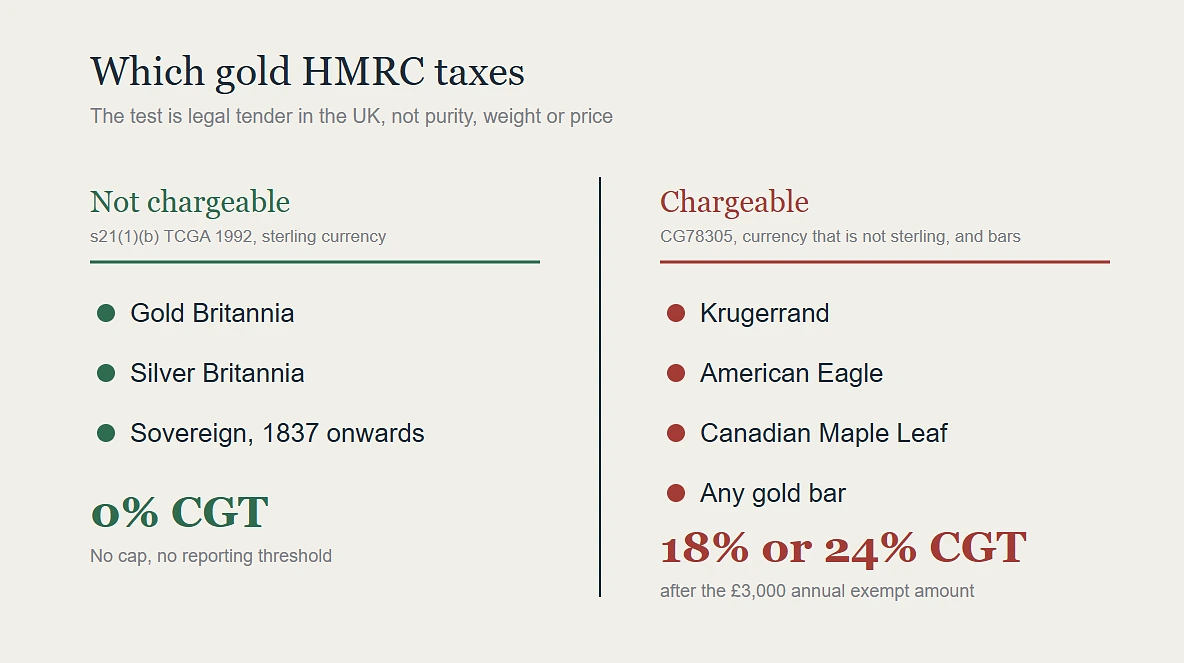
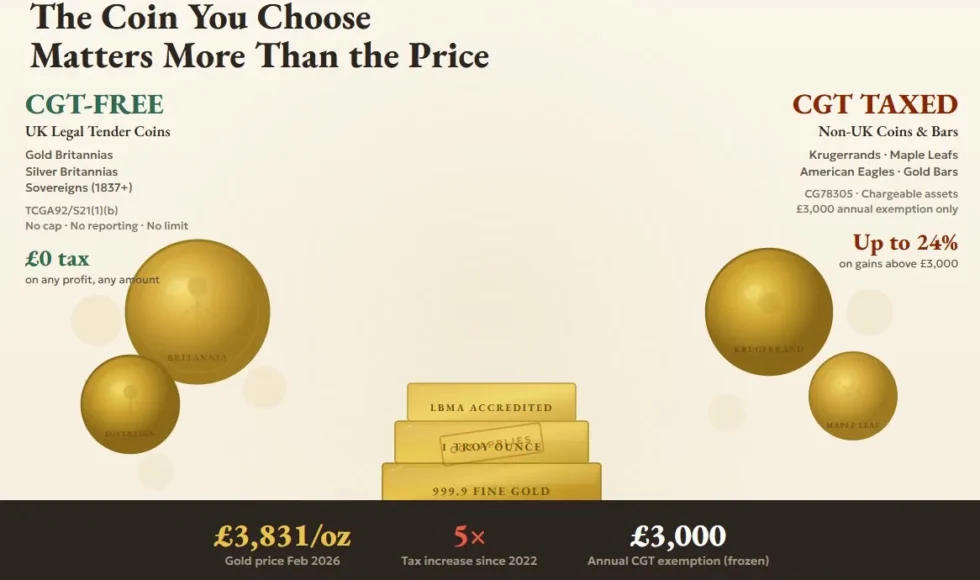
HMRC does not treat gold as gold, because it treats some of it as currency, and the whole question turns on whether the coin in your hand is legal tender in the UK, not on its weight, its purity or what you paid for it.
Section 21(1)(b) of the Taxation of Chargeable Gains Act 1992 says sterling currency is not a chargeable asset, and a coin that is UK legal tender is sterling currency, so gold Britannias, silver Britannias and Sovereigns struck from 1837 onwards sit outside Capital Gains Tax altogether. You could hold £500,000 of gold Britannias, watch them triple, sell every one and owe HMRC nothing, and the Royal Mint says as much in its own guidance, with no cap on the amount, no reporting threshold and no limit on how many you buy or sell.
The other side of the line is in HMRC’s Capital Gains Manual at CG78305, and it is short. Coins that are currency but not sterling are chargeable assets, which takes in Krugerrands, American Eagles and 1 oz Canadian Maple Leaf gold coins, all of them legal tender somewhere and none of them here. Gold bars get the same treatment for the simpler reason that a bar is not currency anywhere, and it makes no difference whether it is LBMA-accredited, 999.9 fine or sitting in a Brink’s vault.
Two people can buy an ounce each on the same morning at the same price, one a Britannia and one a Maple Leaf, sell on the same afternoon for the same money, and one of them pays nothing while the other hands over nearly a quarter of the profit. That is the whole of the rule, and I still meet people who have held bars for a decade without having heard it.
Where International Coins Still Make Sense
Reading the section above, the obvious move looks like never buying anything but Britannias, and for a lot of UK holders that is right, though not for all of them.
A Maple Leaf is 99.99% pure, the same as a Britannia has been since 2013 and a good deal purer than a Sovereign at 91.67%, and it is recognised and traded everywhere, which matters to anyone who might sell in Toronto or Singapore rather than Birmingham. Someone with ties abroad, or a plan to move, may hold internationally recognised coins for reasons that have nothing to do with UK Capital Gains Tax and everything to do with where they will be standing when they sell.
VAT does not separate the two, either. Investment gold, bars and qualifying coins alike, is exempt from VAT in the UK under HMRC Notice 701/21A, and that covers Maple Leafs, Krugerrands and Eagles as much as UK coins, so the purchase price is the same whichever you pick and the difference only shows up on the way out. Some advisers build a mixed holding on that basis, UK coins as the core because they are exempt, and a smaller allocation of international coins or bars for cross-border liquidity or currency spread, and where that split falls depends on the person rather than on a rule.
What Happens To Gold When Someone Dies
Gold does not disappear when its owner does, though the planning around it often has.
Every coin, bar and collectible piece forms part of the estate for Inheritance Tax, and there is no gold exemption of any kind, legal tender or not. The Capital Gains Tax exemption on Britannias and Sovereigns counts for nothing once IHT is the tax in question, and the thresholds it is measured against have not moved in a long time:
- The nil rate band has been £325,000 since 2009.
- The residence nil rate band is £175,000.
- Both are confirmed frozen until at least April 2031.
- From April 2027 unused pension pots come into the IHT calculation for the first time, with the government’s own estimate at roughly 10,500 estates newly caught.
While the bands stood still, asset values did not, gold least of all, and the result is more estates crossing into the 40% band every year with no change in the law. IHT raised a record £8.2 billion in 2024/25 and the OBR has it at £9.1 billion this year and more than £14 billion by the end of the decade. The pension change catches gold holders in particular, because a person who assumed the pension sat outside the estate and the coin collection would never tip them over the band may now find both counted together.
Then the practical side, which is where probate goes wrong. Where is the gold, is it written down anywhere, and do the executors know it exists? A safe deposit box no one was told about, or 40 Sovereigns with no purchase records, turns a valuation into an argument. Purchase receipts, serial numbers and dealer invoices are what stop HMRC disputing the figure, and for any non-exempt gold they are also what let the heirs establish a base cost for their own Capital Gains Tax later.
What The November 2025 Budget Confirmed
The November 2025 Budget left the Capital Gains Tax rates alone, since they had already gone up 13 months earlier, and instead confirmed several things that bear on anyone holding tangible wealth:
- The CGT annual exempt amount stays at £3,000 for 2026/27, with no inflation adjustment.
- Business Asset Disposal Relief rises to 18% from April 2026, up from 14%, in line with the main lower rate.
- The IHT nil rate band and the residence nil rate band stay frozen until 2031.
- Agricultural Property Relief and Business Property Relief are capped from April 2026: 100% relief on the first £1 million, then 50%, which works out as an effective 20% IHT rate above that.
- Pensions come into IHT from April 2027.
- A High Value Council Tax Surcharge starts in April 2028 on homes worth £2 million or more, from £2,500 a year rising to £7,500 above £5 million.
None of those lines mentions gold. All of them narrow the space in which gold gets held, passed on and sold.
Why CGT Receipts Fell When The Rates Went Up
HMRC’s own receipts figures tell a story the Treasury did not plan for. Capital Gains Tax brought in close to £17 billion in 2022/23, £14.5 billion in 2023/24 and £13.1 billion in 2024/25, falling each year while the rate went up and the exemption came down, and the first half of calendar 2025 was down again, by 12.9% on the year before. Wealth managers have been saying the same thing about it since the summer: people are not selling. Put the rate up and the allowance down and the rational holder sits tight, and Jason Hollands at Evelyn Partners called it the “futility of over-taxing investors”.
For a gold holder that produces a split that I think is underrated. Exempt UK coins can be sold whenever the price is right, this week if this week is right, with no thought to the tax year. Non-exempt holdings pull the owner into allowance management instead, spreading sales across April 5ths, offsetting losses, holding back a sale that made sense on price because it did not make sense on tax, and that is the kind of decision-making that planning at the point of purchase is supposed to spare you.
Questions To Ask Before Buying, Not After Selling
There is no single right way to hold gold in the UK. There are questions that get asked too late.
How long is it being held for?
Long-term wealth preservation points at exempt UK coins, because they remove the biggest variable. A shorter horizon, or an international purpose, may point at non-UK coins or bars, and then the tax consequence has to be priced in on day one rather than discovered on the last.
Is it part of an estate plan?
If it is, the IHT exposure needs mapping, and this is where I would correct something that gets repeated a lot. A gift made more than 7 years before death falls outside the estate, and gifting gold is a normal way to use that, but a gift to anyone other than a spouse or civil partner is a disposal at market value for Capital Gains Tax on the day it is made. Give away a Britannia and there is no CGT because there never is on a Britannia. Give away a Krugerrand that has doubled and the giver has a gain to declare that year, even though no money changed hands, and the recipient takes it on at that day’s value as their base cost. The interaction between the two taxes is where most people trip, and it usually trips them on the coins they thought were the simple part.
Are the records being kept?
HMRC can open an enquiry years after a sale. Invoices, storage agreements, insurance valuations and disposal records should exist as a matter of routine, and for an estate the executors have to find and value every piece at probate, which without records becomes adversarial rather than administrative.
Is anyone qualified looking at it?
The way CGT, IHT, VAT and HMRC’s product-by-product treatment of gold fit together is not something an article settles for an individual, because residency, total estate, income band, other gains in the same year and what a spouse holds all move the answer.
Where That Leaves A Gold Holder?
Gold has been one of the best-performing asset classes of the past 2 years, and the 18% fall since January has not undone that for anyone who bought before 2025. What the run created is a tax consequence that did not exist, or did not matter, when the exempt amount was £12,300 and the rate was 10%.
The rule for UK legal tender coins has not moved. Britannias and Sovereigns are as free of Capital Gains Tax as they were the day the 1992 Act was passed. Everything around them has moved, the rates, the allowance, the IHT freeze, the pensions change, the general direction of travel on wealth, and it is the surroundings that decide what a holder keeps. A Britannia bought this month and a bar bought this month cost the same at the counter. The difference between them gets settled on the day they are sold, or the day their owner dies, and only one of those dates is chosen.