
There’s an old saying —
A fool and his gold are soon parted.
These days, though, it’s not the fool losing it. It’s HMRC taking a slice.
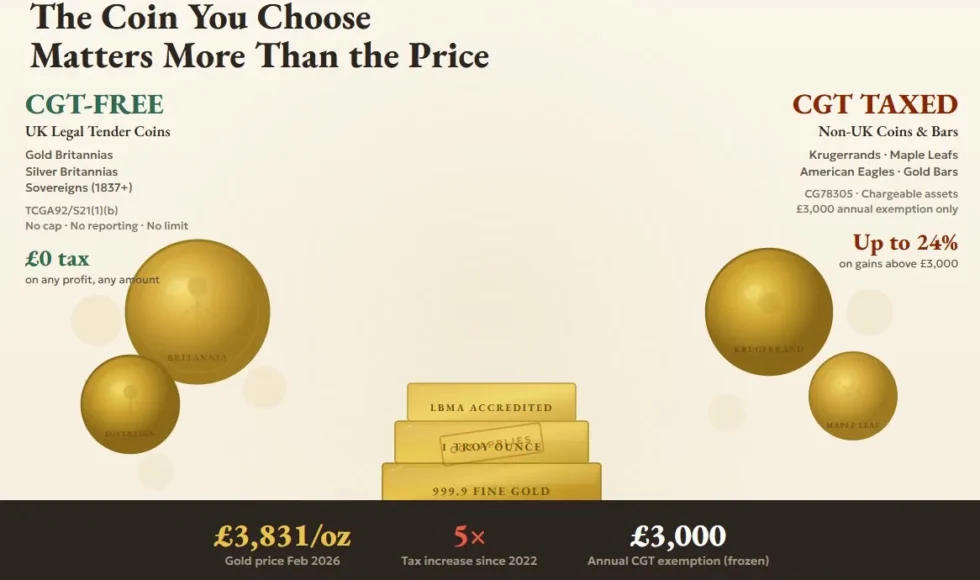
Gold had its wildest run in almost half a century last year. In sterling terms, the price climbed over 53% through 2025 alone, starting the year around £2,097 per ounce and peaking near £3,358 by late December. As of February 2026, it’s hovering around £3,831. That kind of surge hasn’t happened since the late 1970s, when stagflation and geopolitical chaos sent investors scrambling for anything they could physically hold.
Central banks bought 863 tonnes of gold in 2025, according to the World Gold Council. Total global demand crossed 5,000 tonnes for the first time ever. Meanwhile, ETF inflows hit their second-strongest year on record. None of this is slowing down.
But here’s where it gets interesting — and where most UK investors aren’t paying close enough attention.
The Tax Landscape Shifted Underneath Everyone’s Feet
Rachel Reeves’ October 2024 Budget hiked Capital Gains Tax rates with immediate effect. The lower rate went from 10% to 18%. The higher rate jumped from 20% to 24%. For anyone holding gold bars, non-UK coins, or other chargeable assets, that’s a significant jump on profits they might have been sitting on for years.
Then came the quieter blow. The CGT annual exempt amount — the slice of profit you keep tax-free — had already been carved down from £12,300 in 2022/23 to £6,000 in 2023/24, and then to just £3,000 from 2024/25 onwards. That’s a 75% reduction in three years. HMRC confirmed in the November 2025 Autumn Budget that the £3,000 threshold stays frozen for 2026/27 as well.
Put those two changes together and the maths stops being theoretical.
A higher-rate taxpayer who bought £20,000 of gold bars in 2022 and sells them in 2026 for £35,000 faces a £15,000 gain. After the £3,000 exemption, that’s £12,000 taxable at 24%. A CGT bill of £2,880.
Under the old rules — 20% rate, £12,300 exemption — the same person would have owed £540.
Same gold. Same investor. Five times the tax.
Not All Gold Is Equal in HMRC’s Eyes
This is the bit that catches people out. HMRC doesn’t treat all gold the same way, and the distinction isn’t about weight, purity, or even price. It’s about legal tender status.
Under TCGA92/S21(1)(b), sterling currency is not a chargeable asset. That means any coin classified as UK legal tender — Gold Britannias, Silver Britannias, Sovereigns minted from 1837 onwards — sits entirely outside Capital Gains Tax. You could buy £500,000 worth of Gold Britannias, watch them triple in value, sell the lot, and owe HMRC precisely nothing.
The Royal Mint confirms this across its own guidance. No cap. No reporting threshold. No limits on how many you hold or sell.
HMRC’s Capital Gains Manual at CG78305 spells out the other side of that line. Coins which are currency but not sterling — Krugerrands, American Eagles, 1 oz Canadian Maple Leaf gold coins — are chargeable assets. The manual is blunt about it. Non-sterling currency coins don’t get the exemption, full stop.
Gold bars? Same treatment. Doesn’t matter if they’re LBMA-accredited, 999.9 fine, or stored in a Brink’s vault. A bar is not currency. Profits get taxed.
So we end up with a peculiar situation. Two investors buy one ounce of gold each on the same day, at the same price. One buys a Britannia. The other buys a Maple Leaf, or a bar, or a Krugerrand. They sell on the same day, at the same price. One pays no tax at all. The other potentially hands over nearly a quarter of the profit.
Where International Coins Fit — Because Tax Isn’t the Only Variable
It would be easy to read the above and think international coins have no place in a UK investor’s thinking. That misses the bigger picture.
Maple Leafs, for instance, are 99.99% pure — higher purity than Britannias (99.99% since 2013, but Sovereigns are only 91.67%). They’re recognised worldwide and carry their own advantages in terms of liquidity in North American and Asian markets. An investor with international ties or plans to relocate may find that holding internationally recognised bullion coins makes practical sense for reasons that have nothing to do with UK CGT.
Then there’s the VAT angle. All investment-grade gold — bars and qualifying coins — is VAT-exempt in the UK under HMRC’s Notice 701/21A. That includes Maple Leafs, Krugerrands, and Eagles alongside UK coins. So the purchase cost is the same. The difference only shows up on disposal.
Some advisers structure mixed holdings — CGT-exempt UK coins as the core position, with international coins or bars held in smaller allocations for specific purposes, such as cross-border liquidity or currency diversification. It’s a planning conversation, not a blanket rule.
The IHT Question Nobody Asks Until It’s Too Late
Gold doesn’t vanish when someone dies. But the planning around it often does.
Physical gold — every coin, bar, and collectible piece — forms part of a deceased person’s estate for Inheritance Tax purposes. There’s no IHT exemption for gold, whether it’s UK legal tender or not. The CGT exemption on Britannias and Sovereigns is irrelevant once IHT enters the picture.
The IHT nil rate band has been frozen at £325,000 since 2009. The residence nil rate band sits at £175,000. Both are now confirmed frozen until at least April 2031. Meanwhile, asset values — gold very much included — have been climbing sharply. The result is that more estates get dragged into the 40% IHT net every year without any change in the rules. HMRC collected £7 billion in IHT receipts in the ten months to January 2025, up £700 million year-on-year.
From April 2027, unused pension pots will be included in IHT calculations for the first time. The government estimates roughly 10,500 estates will become newly liable. That changes the arithmetic for anyone who assumed their pension would sit outside the estate and that their gold holdings wouldn’t tip them over.
Practical custody matters too. Where is the gold stored? Is it documented? Do the executors know it exists? A safety deposit box that nobody knows about, or a coin collection with no purchase records, creates headaches for probate. Appraisals rely on defensible numbers. Purchase receipts, serial numbers, dealer invoices — these aren’t bureaucratic luxuries. They’re what keep HMRC from disputing valuations and what allow heirs to establish a proper cost basis for any future CGT calculations on inherited non-exempt gold.
As the old proverb goes — those who fail to plan, plan to fail. With gold at current levels, the cost of not planning isn’t hypothetical.
What Actually Changed in the Autumn 2025 Budget
The November 2025 Budget didn’t alter CGT rates — those had already been hiked in October 2024. But it confirmed several things that affect anyone holding tangible wealth:
- CGT annual exempt amount stays at £3,000 for 2026/27. No inflation adjustment. No relief in sight.
- Business Asset Disposal Relief rate rises to 18% from April 2026, up from 14%. Matches the main lower rate.
- IHT nil rate band frozen until 2031. The residence nil rate band too.
- Agricultural Property Relief and Business Property Relief capped from April 2026 — 100% relief only up to £1 million, then 50% (effective 20% IHT rate above that).
- Pensions into IHT scope from April 2027. Roughly 10,500 estates newly caught.
- High Value Council Tax Surcharge from April 2028 — properties worth £2 million or more face annual charges starting at £2,500, rising to £7,500 above £5 million.
None of these directly target gold. All of them tighten the environment in which gold is held, inherited, and disposed of.
The Behavioural Shift HMRC Didn’t Expect
Here’s something that rarely gets discussed. HMRC’s own CGT receipts data tells a strange story.
CGT receipts actually fell 8.4% in 2025, dropping to £13.6 billion from £14.9 billion the year before. Wealth managers attributed this to investors deliberately deferring disposals. When the tax rate goes up and the exemption goes down, rational investors don’t sell — they sit tight.
Jason Hollands at Evelyn Partners called it the “futility of over-taxing investors.” The data showed receipts declining despite more assets theoretically being caught, because the behavioural response was to avoid triggering gains at all.
For gold holders specifically, this creates an interesting tension. The CGT-exempt coin route means you can sell whenever the price is right without worrying about timing around tax years. Non-exempt holdings, on the other hand, lock investors into a game of allowance management — spreading disposals across tax years, offsetting losses, and deferring sales that might otherwise make financial sense.
That kind of tax-driven decision-making is precisely what proper planning is meant to prevent.
Structuring It Properly
There’s no single right answer for how to hold gold in the UK. But there are questions that should be asked before buying, not after selling:
What’s the intended holding period? If it’s long-term wealth preservation, CGT-exempt UK coins remove the biggest variable from the equation. If the holding is shorter-term or for international diversification, non-UK coins or bars may serve a different purpose — but the tax consequence needs pricing in from day one.
Is the gold part of an estate plan? If so, IHT exposure needs mapping. Gifts made more than seven years before death fall outside the estate, but gifting gold means the recipient inherits the original cost basis for CGT purposes on non-exempt items. The interaction between CGT and IHT planning is where most people get tripped up.
Are records being kept? HMRC can enquire into disposals years after the event. Purchase invoices, storage agreements, insurance valuations, and disposal records should be maintained as standard. For estates, executors need to locate and value physical gold at probate — without records, that process becomes adversarial.
Is professional advice involved? The interaction between CGT, IHT, VAT, and the specific HMRC treatment of different gold products isn’t something a blog post can resolve for an individual. Every situation has its own variables — residency status, total estate value, income band, other chargeable gains in the same year, spousal transfer opportunities.
The Bottom Line Without the Cliché
Gold has been one of the best-performing asset classes of the past two years. That performance creates tax consequences that didn’t exist — or didn’t matter — when the annual exempt amount was £12,300 and the CGT rate was 10%.
The rules haven’t changed for UK legal tender coins. Britannias and Sovereigns remain entirely CGT-free, exactly as they have been since TCGA92 was enacted. What has changed is everything around them — the rates, the exemptions, the IHT freeze, the pension inclusion, the general direction of UK tax policy on wealth.
For investors, the distinction between gold that’s taxed and gold that isn’t has never carried a higher price tag. Getting it right at the point of purchase is considerably cheaper than trying to fix it at the point of disposal.
Or, as someone wiser than a tax accountant once put it — the best time to plant a tree was twenty years ago. The second best time is now.
This article is for informational purposes only and does not constitute financial or tax advice. Tax rules are subject to change and individual circumstances vary. Readers should consult a qualified tax adviser or accountant before making decisions about gold investments or estate planning.