
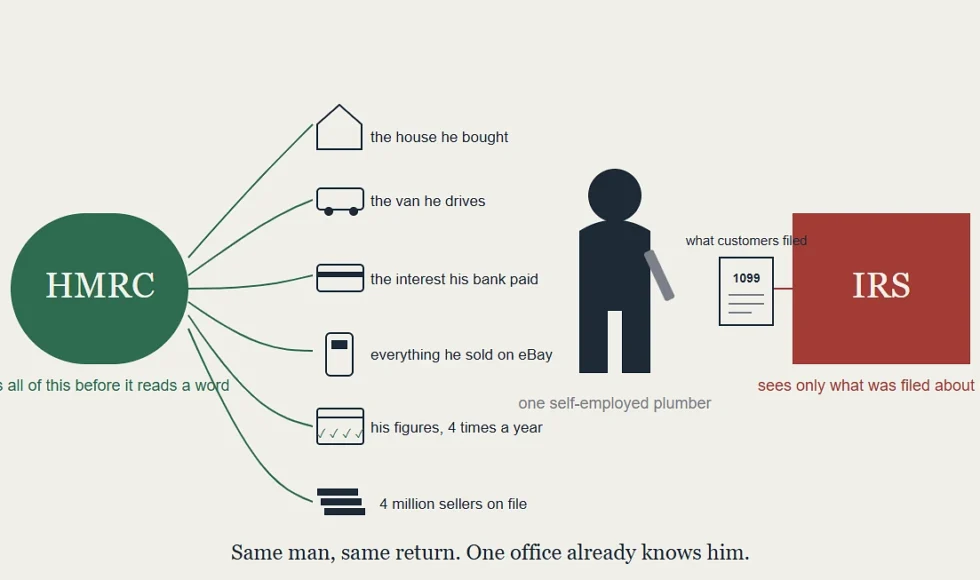
There is an old saying about an iron fist in a velvet glove. Between HMRC and the IRS, one office is the glove and the other is the fist, and most people in this country have them the wrong way round.
Today we are going to see, through one case study, how each tax office looks at a self-employed man, how it decides to write to him, how far back it can reach and what he can do about it, and we are going to see it side by side so the British rules make sense against the American ones.
The values first, so you have something before the story starts:
- The IRS examined fewer than 0.4% of individual returns last year, and did 77.9% of those by post.
- HMRC holds platform income data on almost 4 million online sellers and, since April, sees the self-employed 4 times a year instead of once.
- A careless mistake: 3 years back with the IRS, 6 years with HMRC. A deliberate one: 20 years with HMRC.
One Plumber In Leeds, One In Dallas, One Tax Year
In this case study Dan is the plumber in Leeds and Ray is the plumber in Dallas. Both had been working for themselves for years before the tax year we are looking at, both cleared about £60,000 or the dollar equivalent in it, and if you had asked either of them whether he had anything to worry about on his return he would have said no and meant it, which is roughly where most self-employed people in both countries would put themselves.
What separates the two of them starts the moment each return has gone in, because from there on two very different machines are reading it.
What Each Tax Office Already Knew Before The Return Went In
Connect is what HMRC calls the system Dan’s return went into, and it has been running since 2010, pulling in data from something over 30 outside sources and scoring every return against all of it before any officer has read a word. DIF, short for Discriminant Function, is what the IRS has been doing the same job with since 1969, a scoring formula that has never been published and that ranks a return by how far it sits from the norm for people who look like the filer.
What the two systems had on file before either man pressed send is where the case study starts to separate:
| What the office could already see | HMRC, on Dan | IRS, on Ray |
|---|---|---|
| What he paid for his house | Yes, Land Registry | No |
| What van he drives | Yes, DVLA | No |
| Bank interest earned | Yes, reported by the bank every year | Only if a 1099-INT was issued |
| Platform takings, eBay, Vinted, Airbnb, Uber, Etsy | Yes, sent by the platforms each January since 2025 | Only above the 1099-K threshold |
| What customers and card processors paid him | Partly, through the platform and bank data | Yes, W-2s and 1099s, 4.6 billion of them filed last year |
| Whether the tools he claimed were really bought | No | No |
The platform line has changed the game on this side, because a Freedom of Information request this March found HMRC sitting on 2025 income data for 3,988,892 online sellers, and it had held data on 1.5 million the year before. So if Dan had sold 40 old radiators on eBay in the year, Connect would have known about them before he had even opened his return.
- Before either return has been read by a person, HMRC already knows Dan far better than the IRS will ever know Ray.
People find that surprising, though they should not, since it was built to be that way. The last line of the table is the other thing worth noticing: neither office has any way of checking whether the £4,000 of tools either man claimed were ever paid for, and that gap is where both of them will be looking.
How A Return Gets Picked In Leeds And In Dallas
No one at either office sits reading every return that comes in, since the systems score them first and a person only gets involved once a score is high enough, and when you put the two lists of what pushes a score up next to each other they turn out to be nearer than you might expect.
What raises Dan’s score with HMRC:
- Income declared that does not match what the platforms and banks reported.
- Cash-heavy trade with expenses that look too round to be real.
- A lifestyle Connect can see, the house, the van, a second property, that does not fit the income.
- Losses claimed year after year against other income.
- A margin that changes sharply from one year to the next with no reason given.
What raises Ray’s score with the IRS:
- Schedule C losses for more than one year running.
- A home office that would fail the exclusive-use test under section 280A.
- Vehicle expenses at 98% to 100% business use.
- Round numbers where real receipts would give odd ones.
- Gross receipts below what the 1099-NEC and 1099-K forms already showed.
Look at Dan’s third bullet, though, because nothing like it appears on Ray’s list. HMRC can see how Dan lives, whereas the IRS has only ever been able to see what Ray told it and what his customers told it about him. Ray could have been claiming a home office that does not exist for years, provided the arithmetic stayed tidy, and nothing would have flagged it, while Dan’s second van would have shown up in a government database on the day the logbook changed hands.
Then there is Making Tax Digital, which is the part that changed this April and the reason this case study is being written now rather than last year. Since 6 April 2026 anyone self-employed and earning over £50,000 has had to keep their records digitally and send HMRC a summary every 3 months, with the line coming down to £30,000 next April and £20,000 the April after that. Dan is over it, so HMRC has been getting his figures quarterly since the spring instead of once a year 10 months after the year finished, and Ray, who will file once next April for the year that has just gone, has no equivalent at all. Hmm, and I do not think most people over £50,000 have taken in what that means yet, which is that HMRC is now watching them in something close to real time.
What The Letter Looks Like When It Comes
For Ray In Dallas
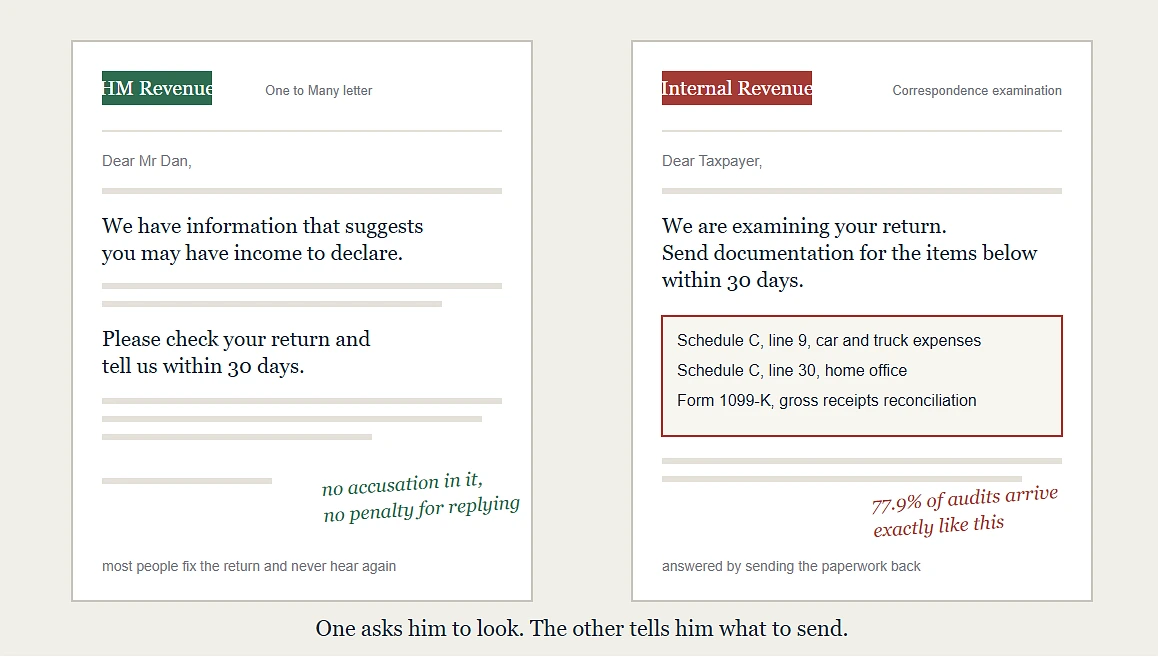
The odds of a letter are low, and when it comes it is usually the mild kind. The IRS examined fewer than 0.4% of individual returns in its 2024 fiscal year, closed 505,514 audits in all, and did 77.9% of them by post: a notice asking for the paperwork behind 2 or 3 lines, answered by sending the paperwork back.
If it goes further than post, an office audit means they want him to come in and bring the books with him, and a field audit means an agent turning up at the yard, which the IRS keeps for the complicated cases and the rich, though according to its own data those visits are where most of the extra tax gets found.
Ray’s first move on anything beyond a correspondence notice would be the same as most self-employed Texans in that position, a call to a tax audit lawyer, in his case David B. Coffin, because the American system expects a taxpayer to turn up represented and treats the ones who do not accordingly.
For Dan In Leeds
Dan is more likely to get a letter than Ray, and when he does it will read a good deal more gently than he had been dreading. HMRC’s usual opening move is not an enquiry at all but what it calls a nudge letter, one of the “One to Many” campaign letters it sends out when its data suggests there might be income missing, and all it asks is that he check his return and reply within 30 days. Nothing in it accuses him of anything and there is no penalty attached to answering it, which is why a great many people put their return right on the strength of one and never hear another word. If HMRC goes further it opens a compliance check under section 9A of the Taxes Management Act 1970, into one aspect of the return or the whole of it, and it runs by post and phone with a named officer. A visit to Dan’s premises is rare unless VAT or PAYE is involved.
This is where I would push back on how the two get talked about, because the American audit has the reputation and the numbers say hardly any American ever gets one, whereas the British compliance check gets shrugged off as admin and HMRC’s compliance work had brought in well over £40 billion by the end of last year.
- One office frightens people and barely looks. The other looks constantly and is polite about it.
How Far Back Each Office Can Reach
This section decides how long the shoebox of receipts stays in the loft, and the two countries count in different directions.
| HMRC, Dan in Leeds | IRS, Ray in Dallas | |
|---|---|---|
| Ordinary window to open a check | 12 months from the date the return was filed, s9A TMA 1970 | 3 years from filing, s6501(a) |
| If the error was careless | 6 years back, s36 TMA | 6 years if income was understated by more than 25%, s6501(e) |
| If the error was deliberate | 20 years back, s36 TMA | No time limit for fraud, s6501(c) |
| Penalty on the tax lost | 0% to 30% careless, 20% to 70% deliberate, 30% to 100% deliberate and concealed, Sch 24 FA 2007 | 20% accuracy-related, s6662; 75% civil fraud, s6663 |
The 12 months looks generous until you read the second and third rows, because HMRC can come back into a year it has already closed if something new turns up, which it calls a discovery assessment, and once it has made one it can reach back 4 years for an innocent mistake, 6 for a careless one and 20 where it thinks the error was deliberate. So the short window only ever protected the people whose returns had nothing wrong with them. The IRS, by contrast, gives itself 3 years as standard and then finds it hard to stretch, since only a large understatement gets it to 6 and only fraud takes the limit off altogether.
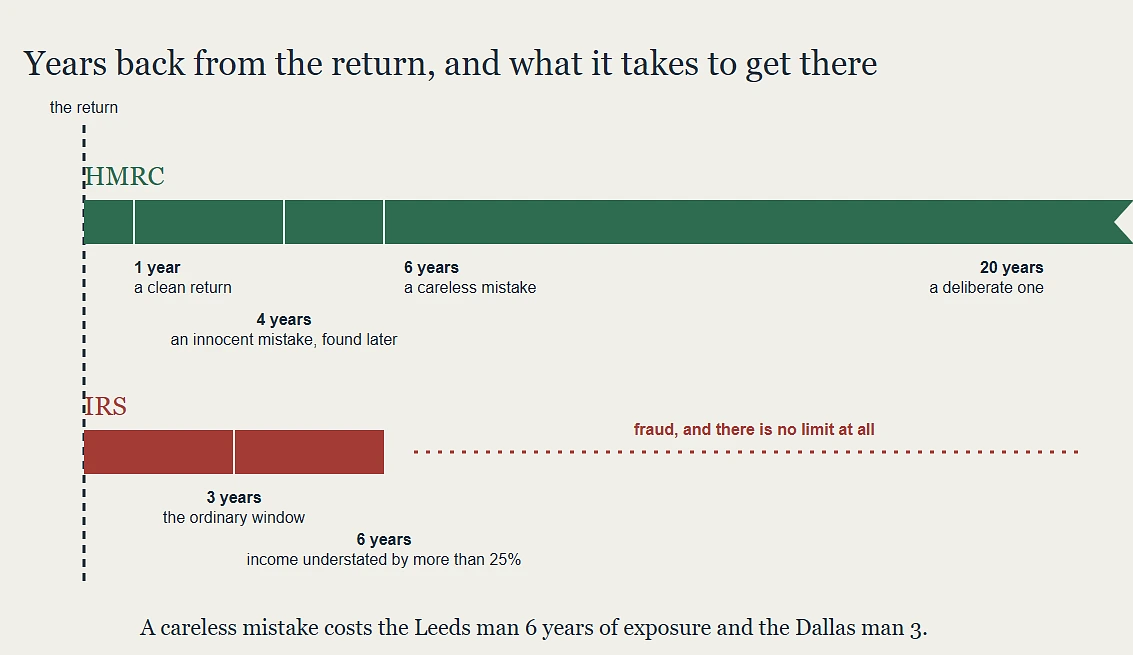
So Dan’s careless mistake costs him 6 years of exposure and a penalty that depends on how he behaves once asked, because Schedule 24 pulls the percentage down for a prompt and full disclosure. Ray’s careless mistake costs him 3 years and a flat 20%.
What Each Man Can Do About It
Ray has an appeal, and it goes first to the IRS Independent Office of Appeals, which was set up to sit apart from the examiners who raised the deficiency in the first place. Should that fail, the IRS sends him a notice of deficiency, and from the date on it he has 90 days to petition the US Tax Court, where the case gets argued before a dollar of the disputed tax has to be paid. He is entitled to have a lawyer with him at every stage of that under the Taxpayer Bill of Rights in section 7803, and he would be unwise to go without one, since the examiners will have had theirs.
Dan’s route starts inside HMRC rather than outside it. He can ask for a statutory review, which a different officer carries out, one who had no part in the check, and if that does not settle it there is Alternative Dispute Resolution with a mediator, provided both sides agree to it. After that comes the First-tier Tribunal, which costs him nothing to bring a case to and where a plumber can, and quite often does, stand up and argue it himself.
He may not need any of it. Most compliance checks in this country end in a contract settlement, a signed agreement covering the tax, the interest and a penalty at the bottom of the range because he cooperated, and no tribunal ever hears of them.
The Glove And The Fist
Dan has been watched far more closely than Ray ever will be, and if his return was straight he will most likely never feel any of it, because HMRC uses everything it holds on him, the platform data, the bank data, the house, the van and now the quarterly figures, to decide whom to write to, and when it writes it asks before it accuses. That was the velvet glove from the saying at the top.
Ray gets looked at less and audited less, and it is only on the rare occasion he is audited that the fist shows, in a process that is harder to get through, penalties that do not bend for cooperation the way HMRC’s do, and a lawyer’s number that has to be the first call.
If you are Dan, the practical side is the dull kind:
- Keep the records HMRC cannot see, the receipts behind the expenses, because that is where its data runs out.
- Check the platform figures against your return before HMRC does, remembering that platforms report January to December and the tax year runs April to April.
- Answer a nudge letter inside the 30 days, because the penalty range is built to reward exactly that.
- Keep the shoebox for 6 years, not 1, because the year-long window is only for the returns HMRC never finds anything wrong with.