
Between 1997 and 2003 three American companies, Hershey, Nike and Nestle USA, each put a new enterprise system into a business that was running perfectly well on the old one, and each of them had fixed the go-live date long before anyone could say whether the new system worked. Two of the dates were set by the millennium bug. One was set by the sales calendar. All three companies ended up on SAP, which is worth saying at the start, because the software turned out to have very little to do with what happened next.
As a small business, in Britain or anywhere else, what can we learn from these big American giants? That is what this article is for. We are going to go through what each of them did, see the mistake at the point it was made, and take the lesson from it for ourselves, because the same mistake on a £20,000 system costs a small business in exactly the same way, orders that do not go out and invoices that do not go in. The names are big. The mistakes are ordinary ones.
ERP Software Transformations For Business Operations: Three Business Examples And What Each One Cost
What follows is what each of them switched on, what broke, what it cost on the record, and in one case what it took to put right.
Hershey And The Halloween Orders Of 1999
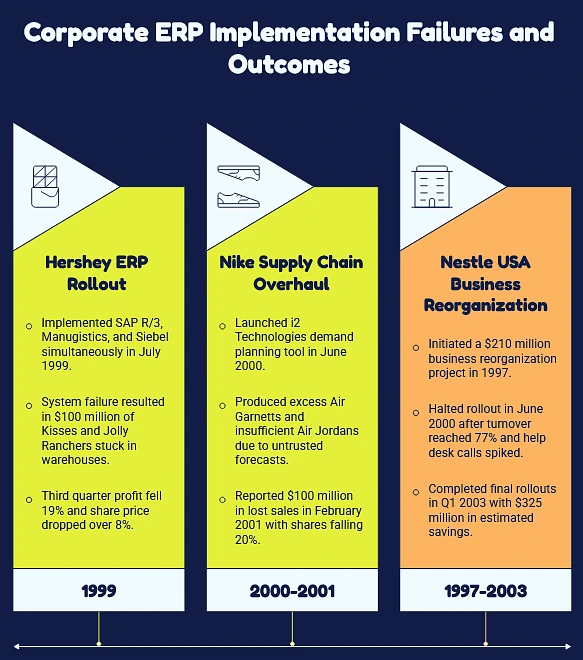
Hershey had been told a rollout of that size needed 48 months and gave it 30, because the date that mattered was not the go-live date at all, it was 31 December 1999. The company had brought in an ERP software company for the core, a second vendor for the supply chain and a third for customer records, SAP R/3, Manugistics and Siebel, on a programme costed at $112 million, and it switched all three on together in July 1999. July is when the Halloween and Christmas orders arrive.
The orders came in and the system could not get them out of the door. Around $100 million of Kisses and Jolly Ranchers sat in warehouses while shelves went empty in the weeks before Halloween. Third quarter profit fell 19%, the share price fell more than 8% on the day the problem was announced, and the Wall Street Journal ran it on the front page. Testing had been cut to hit the date. Even reading it now I can feel this coming from the July go-live onwards, and I have no idea how a management team that sells most of its year in 2 months could not. When the systems were examined afterwards, nothing in the software itself was found to be broken, and Hershey has run on the same SAP core ever since.
Nike, The Air Garnett And $100 Million In Missing Orders
Nike’s programme was a $400 million overhaul of its whole supply chain, and the piece that failed was the smallest part of it, a demand planning tool from i2 Technologies that went live in June 2000, about 9 months before the SAP core it was meant to feed. The planner had been customised heavily, it was slow, with a single entry taking up to a minute to register, and it was producing forecasts on its own logic that the people in the business did not trust. Which is the part I keep stopping at, because if the planners themselves did not believe the forecast then who was it for, and Nike went on making shoes to it for the best part of a year anyway.
The result showed up in the shoes. Nike made far too many Air Garnetts, which retailers had not asked for, and far too few Air Jordans, which they had. In February 2001 the company said it would miss its third quarter by about $100 million in lost sales, the shares fell 20% in a day, and Phil Knight’s line to analysts was:
“This is what we get for our $400 million, huh?”
i2 said Nike had gone live without following its implementation method and had customised the software too far. Nike said the software had not been fit for its scale. Each blamed the other, and the point the CIO magazine post-mortem kept returning to was that neither of them had said stop. Nike then moved short and medium range planning into SAP and kept i2 for the long range only, and by 2004 it was reporting the programme as 80% complete, gross margin up from 39.9% to 42.9%, and a total bill closer to $500 million.
Nestle USA, The Rollout That Stopped Halfway
Nestle USA’s project had started in 1997 with a wider problem than software. Jeri Dunn, the CIO, found 9 general ledgers, 28 points of customer entry and factories buying from the same suppliers at different prices because each one had set up its own vendor file, and the plan she put to the board was a business reorganisation with SAP underneath it, costed at $210 million over 6 years. Her line to the executives at the time was that there would be pain, that it would be slow, and that this was not a software project.
Then Y2K arrived and the date took over. Four SAP modules and the Manugistics supply chain tool were pushed live before the end of 1999, the integration between them had been left for later, and the people who would be using them had not been in the room when the processes were designed. By early 2000 turnover in the affected groups had reached 77%, the help desk was taking 300 calls a day, and in June 2000 Dunn halted the rollout and took the project team to a 3 day offsite that she has described as having started as a gripe session. I see the same thing in every one of these and this is the only one where someone said stop, and it is the only one of the 3 that came out the other side with a number the CIO was willing to put her name to.
What set Nestle apart was that somebody stopped the rollout with 4 modules live and the rest unbuilt. The remainder was done slowly, division by division, with the supply chain tool swapped for SAP’s own, and the last rollouts landed in the first quarter of 2003. Dunn’s claim in 2002 was $325 million saved, most of it from demand forecasting that all of Nestle USA now did from the same numbers, and because Nestle files no accounts with the SEC that figure is hers rather than an audited one. On her own estimate the late switch of supply chain tool alone had cost about 5% of the whole budget.
The Bill That Is Not On The Software Invoice
| The date was fixed by | Went live | What it cost, on record | |
|---|---|---|---|
| Hershey | Y2K | July 1999 | $100m of orders unshipped, profit down 19% |
| Nike | Its busiest season | June 2000 (the planner) | $100m lost sales, shares down 20% |
| Nestle USA | Y2K | December 1999, halted June 2000 | $210m programme, 77% staff turnover |
Every figure in that table is the headline number, and underneath each one sits a second bill that never appears on the vendor’s invoice, which is the cost of doing by hand what the system had been bought to do. Hershey’s was warehouses full of stock that had been made, paid for and could not be sold. Nike’s was a season of the wrong shoes. Nestle’s was 2 years of a business running half on the old systems and half on the new. Hmm, and none of these 3 second bills had been in the project budget, which is the bit for the rest of us, because the budget only ever covered the software and the workaround came out of that year’s trading. The same second bill turns up at any size, and it is not confined to companies or to the last century; Birmingham City Council, which went live on Oracle in April 2022 and has done part of its accounting by hand since, set aside £5.3 million in a single year for temporary staff to cover the gap.
Scale it down to a firm with 40 staff and a new system that went live on the first of the month because the old licence ran out, and the shape holds. Invoices go out late or wrong for 6 weeks, customers pay late because the invoices were wrong, and the gap gets covered the quickest way available, which for a lot of small businesses in 2026 means a merchant cash advance taken against card takings. A second one tends to follow while the first is still being repaid, and by then the finance director, if there is one, is looking at MCA debt consolidation rather than at the system that started it.
None of the three companies found a fault in the software when it was examined afterwards. Hershey shipped Halloween 2000 on time. Nike’s programme ran to 2004. Nestle USA’s last rollout landed in the first quarter of 2003, 6 years after Dunn had told the board it would be slow.
What Actually Makes the Difference
Looking at these five companies, the pattern is obvious. Success or failure had almost nothing to do with which ERP system they picked. Walmart, Nestle, Nike all ended up with SAP. Hershey failed with SAP too, at least initially.
The companies that succeeded:
- Took their time with implementation (Walmart).
- Trained employees thoroughly before going live.
- Ran pilot programs and fixed problems before full rollout.
- Kept old systems running during transition periods.
- Had strong project management and clear communication.
The companies that failed:
- Rushed implementation to meet arbitrary deadlines.
- Launched during busy periods (Hershey, Nike).
- Didn’t test systems properly before going live.
- Failed to train employees adequately.
- Had poor communication between departments.
Even the failures eventually recovered. Nestle turned their disaster into $325 million in savings. Nike rebuilt their supply chain stronger than before. But they all paid heavily for their mistakes – in money, time, market share, and reputation.
References
- https://www.uwosh.edu/faculty_staff/wresch/ERPNestle.htm
- https://www.cio.com/article/264637/enterprise-resource-planning-nike-rebounds-how-nike-recovered-from-its-supply-chain-disaster.html
- https://www.cio.com/article/270245/supply-chain-management-supply-chain-hershey-s-bittersweet-lesson.html
- https://www.techspot.com/news/109650-birmingham-faces-catastrophe-oracle-project-costs-balloon-20m.html
- https://www.cio.com/article/270680/enterprise-resource-planning-nestl-s-enterprise-resource-planning-erp-odyssey.html