
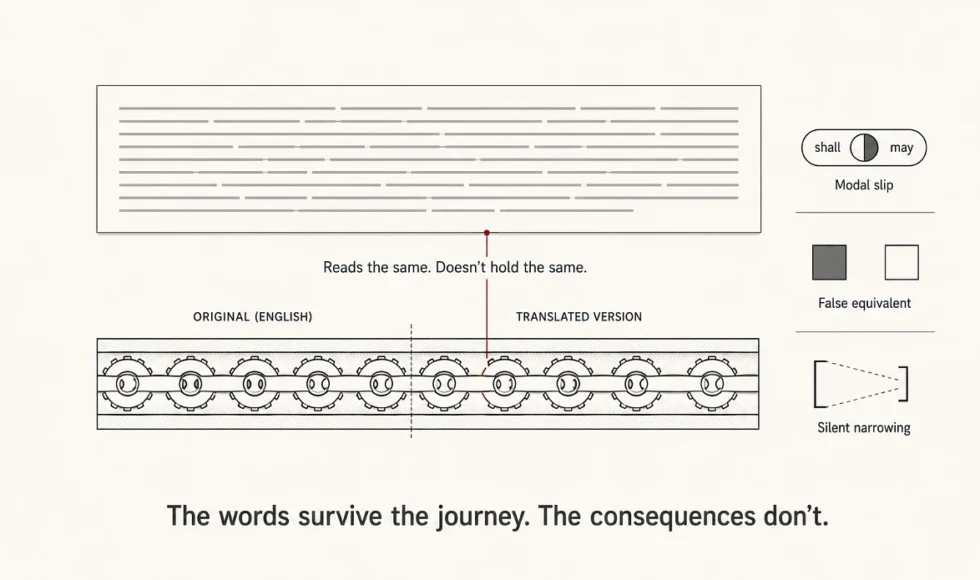
There is a moment in most cross-border deals that never appears in the project plan. The commercial terms are agreed. Someone has read the English version three times. And then it emerges that the counterparty needs the whole thing in their own language, and they need it before the end of the week.
What happens in the next few hours often decides whether the agreement holds up later. In our experience advising businesses on documents that cross a language border, translation is treated as an administrative task bolted onto the end of a legal process. It is not. It is a drafting decision, and it is usually made under time pressure by whoever happens to be free.
Here is what tends to go wrong, and what a sensible process looks like before anything gets sent.
The document you translate is not always the document you signed
A contract is not a piece of prose. It is a set of instructions written in a technical dialect, where individual words carry defined consequences. Translate it as prose and the sentences will read beautifully while the obligations quietly move.
The Shanghai Maritime Court made this point unusually publicly. Reviewing two years of its archives, the court reported that translation errors in key contract terms had triggered disputes between Chinese and foreign companies, and although such cases made up less than 5 percent of all cases, the losses involved were significant and entirely avoidable. In one case, “drydocking” had been rendered as “tank washing”, and a clause covering fuel “for domestic service” came back as fuel “for domestic flights”. Two small slips. Two completely different sets of obligations, and an expensive fight over which version governed.
That court hears shipping disputes, so the vocabulary is specialist. The failure mode is not. It shows up in supply agreements, distribution deals, employment terms and confidentiality agreements written by ordinary businesses in ordinary language.
Three failure modes, in order of how often we see them:
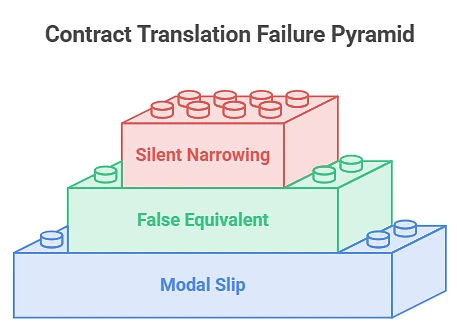
- The first is the modal slip. English contracts hang enormous weight on “shall”, “must”, “may” and “will”. Many languages do not distinguish between them as sharply, and a translator working without legal training will pick whichever reads more naturally. A binding obligation becomes something the other side may consider doing.
- The second is the false equivalent. Some concepts simply do not exist across legal systems. English contract law binds on consideration. French civil law binds on cause. Translating “consideration” into the ordinary French word for a counterpart or exchange produces a clause that points at a doctrine which is not there. The sentence is grammatical. The clause is hollow.
- The third is the silent narrowing. A term of art gets swapped for a near neighbour that sounds similar and protects far less. Exclusive rights become preferred status. An indemnity becomes a promise to be reasonable. Nobody notices until someone tries to rely on it.
Figure 1: The words translate cleanly. The obligation does not.
Why this is landing on more UK desks than it used to
This used to be a problem for multinationals with in-house counsel. It is now a problem for firms with twelve employees and one export market.
Take Japan, which is a useful example because the legal and linguistic distance from English is wide and the trade volume is not small. Department for Business and Trade figures put total UK trade with Japan at £34.6 billion in the four quarters to the end of Q4 2025, an increase of 2.9 percent on the year before, making Japan the UK’s fourteenth largest trading partner. Behind that number sit thousands of supplier agreements, licensing deals and confidentiality agreements, most of them signed by companies with no Japanese speaker on staff.
Figure 2: Rolling four-quarter totals. Source: UK Department for Business and Trade.
The same dynamic plays out with Russian, Polish, Arabic and Chinese counterparties. The pattern we keep meeting is a business that has done the hard commercial work properly and then handed the most consequential document in the relationship to whichever tool was already open in a browser tab.
It is worth remembering how differently the same facts can be treated once you cross a border. We have seen elsewhere on this site that an identical rear-end collision pays a fixed tariff of roughly £840 in England and six figures in Nevada. Contract language behaves the same way. The words survive the journey. The consequences do not.
The NDA problem, and why it is a good stress test
Non-disclosure agreements are the document we would point to first, because almost every business signs them, almost nobody reads them closely, and they are frequently the very first thing sent to a foreign counterparty. They are also short, which makes people careless.
Japanese is a good illustration. There is no single settled Japanese equivalent of “non-disclosure agreement”. Several conventions circulate in commercial practice, including 秘密保持契約 and 機密保持契約, and drafters also use phrasing built around 守秘義務, the duty of confidentiality itself. They are not interchangeable in tone or in the scope a Japanese lawyer will read into them. Pick one at random and you have made a substantive drafting choice without knowing it.
This is easy to test before you commit. Comparison tools now run a single phrase through many AI models at once and show where they disagree, which is far more informative than any one output on its own. Running NDA translation from English to Japanese through that kind of side-by-side view makes the ambiguity visible immediately: the models split across the competing conventions rather than converging on one. That disagreement is the useful signal. It tells you exactly which term needs a decision from a lawyer rather than from software.
The general principle holds well beyond Japanese. A single AI output gives you fluent, confident text and no indication of where it was unsure. Consensus across several models gives you a map of the risky clauses. One of those is a translation. The other is a review tool.
Triage the document before you translate it
Not every document deserves the same treatment, and pretending otherwise is why budgets get spent in the wrong place. Marketing copy translated imperfectly costs you a little polish. A confidentiality clause translated imperfectly costs you the protection you were buying.
The framework below is the one we use to sort documents before any translation work starts.
Figure 3: Sort the document first. The tier determines the process, not the deadline.
Most of the pain we encounter comes from Tier 1 documents being handled with a Tier 4 process, usually because the deadline made the decision. Tier 2 is the quieter trap: a filing can be linguistically perfect and still be rejected on formatting, which costs weeks rather than money. If you are unsure which filings apply to your structure, your accountants for limited companies will know before you do.
A short checklist for the hour before you press send
- Name the controlling language in the contract itself, and do it before translation rather than after. If both versions have equal authority, you have created a dispute mechanism rather than resolved one.
- Isolate the operative clauses. Governing law, termination, indemnity, liability caps, payment triggers and confidentiality scope. These get human legal review regardless of what any tool produced.
- Look for disagreement, not fluency. Where several models produce materially different renderings of the same term, that term needs a decision. Where they converge, your risk is lower.
- Ask for a back translation on anything binding. Translating the target text back into English independently exposes shifts that reading the target version never will.
- Lock terminology before the negotiation, not after. Once a term has appeared in three rounds of drafts in two languages, changing it becomes a commercial conversation instead of an editorial one.
- Check what your counterparty’s version actually says. Where a foreign-language version is stated to prevail in any dispute, that version is the contract. The English one is a summary you happen to like.
The cheapest possible moment to fix this
Translation errors are not usually discovered when they are made. They are discovered when someone tries to enforce a clause and finds it does not say what they thought. By then the fix involves lawyers in two jurisdictions and a commercial relationship that has already soured.
The cost of getting it right beforehand is a few hours and a conversation with someone who understands both the language and the legal system it operates in. The cost of getting it wrong is measured in the same currency as the deal itself. It is worth reading more on the business and commercial side of these decisions before your next cross-border agreement reaches the signing stage.
Translate the contract last, and you are documenting a risk. Translate it as part of the drafting, and you are preventing one.