

A driver gets rear-ended at a junction. The impact throws their head forward and back. They walk away, feel stiff the next morning, and spend the following twelve months dealing with neck pain, physiotherapy appointments, and disrupted sleep. In England, that injury pays a fixed tariff of roughly £840 (NOT TO BE CONFUSED WITH THIS NUMBER THIS IS AN EXAMPLE) under the Civil Liability Act 2018. In Las Vegas, the same injury routinely settles for $100,000.
That isn’t a typo. And it isn’t an extreme outlier on either side.
The Numbers Side by Side
| England & Wales | Nevada (US) | |
|---|---|---|
| Whiplash, 3 months or less | £276 (fixed tariff) | $3,000–$25,000 |
| Whiplash, 6–12 months | £576–£840 | $25,000–$100,000 |
| Whiplash + neck/back, 12–18 months | £840–£3,005 | $75,000–$150,000 |
| Whiplash + minor psychological injury, 18–24 months | Up to £4,345 | $100,000–$250,000+ |
| Who decides the amount | Government tariff (judges cannot exceed except 20% uplift in exceptional cases) | Jury trial or negotiated settlement — no cap on general damages |
| Legal fees structure | No-win no-fee CFAs; costs largely irrecoverable for claims under £5,000 | Contingency fee (25–40% of settlement) |
| Punitive damages available | Essentially no | Yes — rare but available in cases involving fraud, oppression, or malice |
Sources: Whiplash Injury (Amendment) Regulations 2025 (England & Wales); SJW Injury Law and Brian Boyer Injury Law settlement data (Nevada, 2022–2024); Judicial College Guidelines 17th Edition.
What a Rear-End Collision Looks Like in Las Vegas
In October 2023, a law firm in Las Vegas — SJW Injury Law — settled a rear-end collision case for $100,000. The client had suffered injuries to their neck and back after being hit from behind on the I-215. A separate case from the same firm that year, involving a rear-end impact while the driver was parked in a car park, settled for $123,777. Another rear-end case in November 2023 where the client sustained whiplash resolved at $105,000.
These aren’t exceptional verdicts from drawn-out jury trials. They’re negotiated settlements reached between the claimant’s attorney and the at-fault driver’s insurance company. The typical pattern in Nevada involves medical documentation of the injury, calculation of economic losses (medical bills, lost earnings), and then a “pain and suffering multiplier” — usually 1.5x to 5x the economic damages — applied to arrive at a settlement range.
Las Vegas car accident lawyers operating on contingency fees have a direct financial incentive to maximise the settlement value, because their fee (typically 33% pre-litigation, 40% if it goes to trial) comes out of whatever they recover. That structure shapes how aggressively cases are built, how thoroughly injuries are documented, and how firmly lowball offers from insurers get rejected.
Nevada also operates under a modified comparative negligence rule — if the claimant is 50% or less at fault, they can still recover damages, reduced proportionally. And if a case doesn’t settle, it goes to a jury trial, where twelve members of the public decide the damages figure. Juries in Clark County (Las Vegas) have a well-documented tendency to award generously in clear-liability rear-end cases.
What the Same Crash Looks Like in England
As the saying goes — a different kettle of fish entirely.
Since 31 May 2021 road traffic accidents resulting in whiplash injuries in England and Wales have been subject to a fixed tariff under the Civil Liability Act (CLA) 2018. The government — not a judge, not a jury — determines how much compensation is provided based entirely on the duration of symptoms.
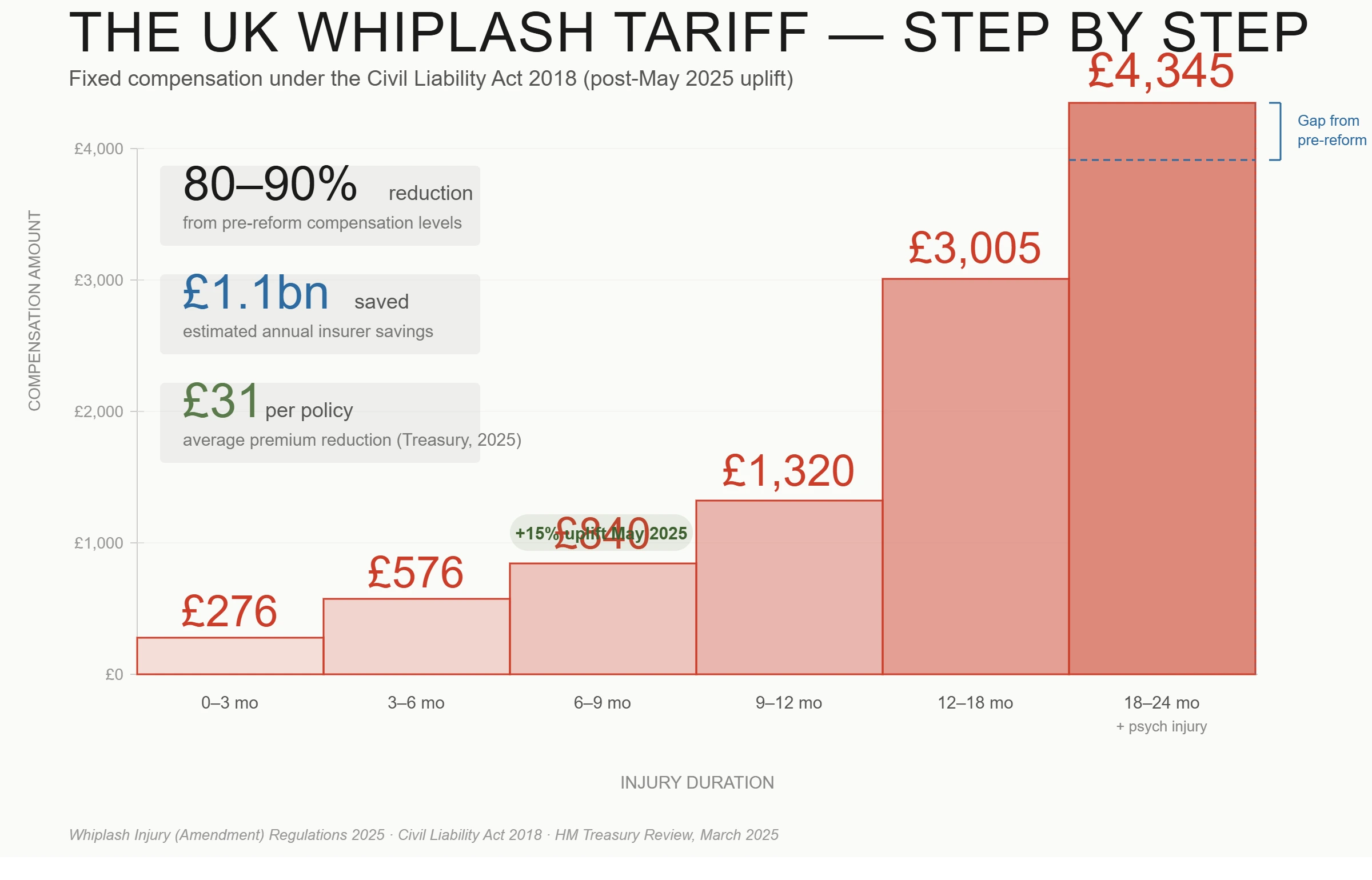
The 2025 Regs (which came into force on 31 May 2025) applied a 15% inflationary uplift to the 2021 tariff. Those figures, even after that increase, are still modest in any international comparison. A whiplash injury of up to three months pays £276. Duration: six to nine months, from £576 – £840. twelve to eighteen months without a major psychological injury, up to £3,005.
The highest tariff — for whiplash with a minor psychological injury lasting eighteen to twenty-four months — is £4,345. That works out to about $5,400 at today’s exchange rate.
Judicial discretion empowers the uplift to be up to 20% on the tariff in exceptional circumstances, however “exceptional” has been interpreted narrowly by courts. The vast majority of whiplash claims settle at tariff through the Official Injury Claim (OIC) portal, a government-run online system in which claimants submit their own claims — no solicitors involved. While legal representation can be pursued, recoveries are generally unrecoverable for less than £5,000 in claims value and as such are often handled by the claimants themselves.
No jury. No multiplier. No pain-and-suffering negotiation. A fixed number from a government table, based on duration alone.
Why the Gap Exists — And It’s Not Just About Generosity
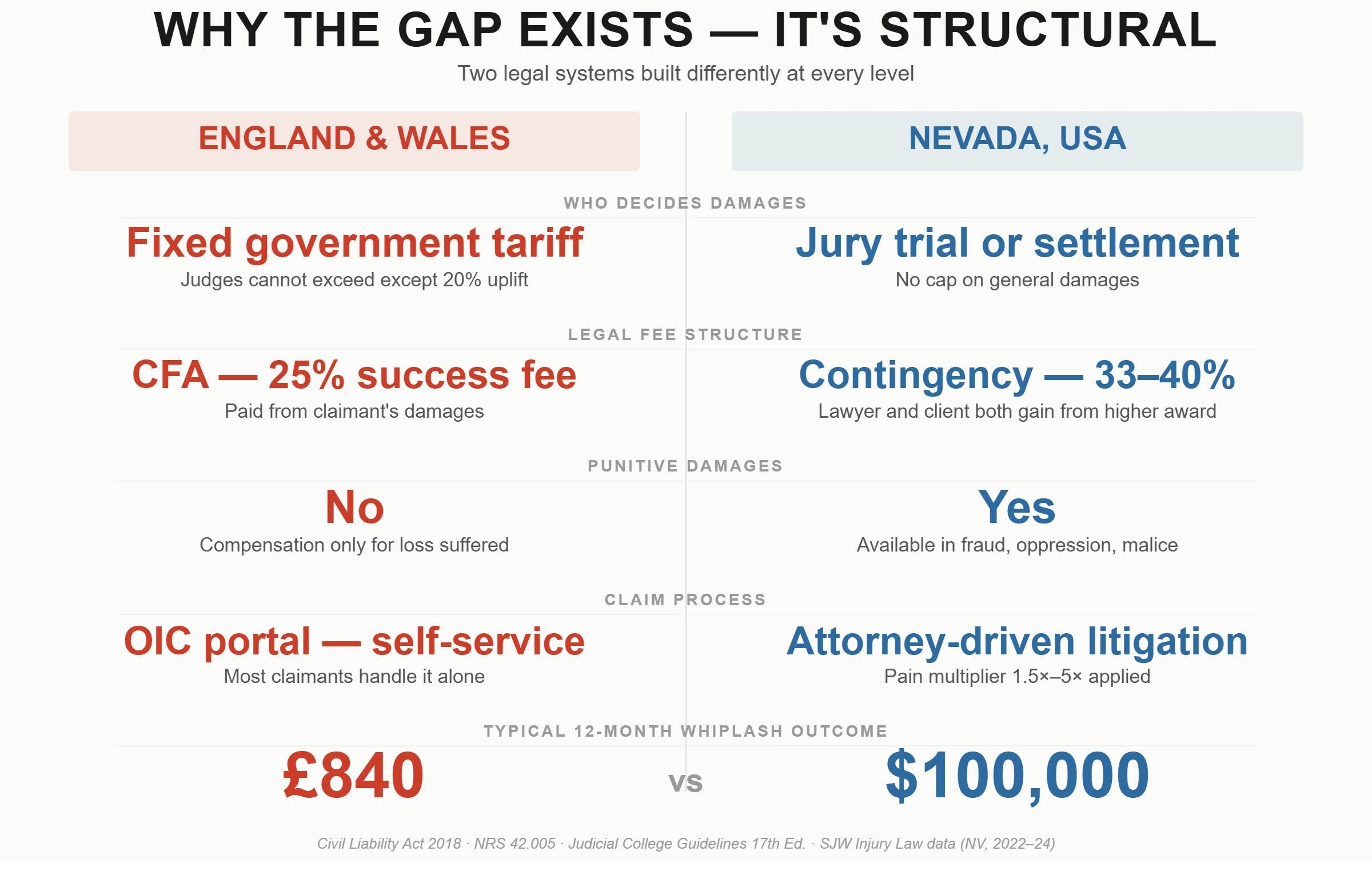
The difference isn’t random and it isn’t purely cultural. It’s structural, built into the legal architecture of each system.
- Jury trials versus judge-only proceedings. In Nevada, personal injury cases that don’t settle go before a jury. Twelve people hear testimony about pain, disruption to daily life, and emotional distress, and they assign a number. In England, personal injury claims under £5,000 are processed through the small claims track or the OIC portal — no oral hearing in most cases, no jury at any stage. Higher-value claims go before a judge sitting alone, who applies Judicial College Guidelines rather than personal discretion.
- Contingency fees versus conditional fee arrangements. American contingency fees create alignment between lawyer and client — both benefit from a higher settlement. The UK’s conditional fee arrangement (no-win no-fee) works differently: solicitors can charge a success fee capped at 25% of the client’s damages, but that success fee comes out of the client’s compensation, not from the defendant. For a £840 whiplash tariff, paying a solicitor 25% leaves the claimant with £630 — which is why most low-value whiplash claimants don’t use solicitors at all.
- Punitive damages. Nevada law permits punitive damages in cases involving fraud, oppression, or malice — NRS 42.005. These awards sit on top of compensatory damages and can multiply the total recovery dramatically. English law effectively prohibits punitive damages in personal injury claims. Compensation covers what the claimant lost and suffered, nothing more.
- The policy intent behind the UK tariff. The Civil Liability Act 2018 was explicitly designed to reduce the volume and cost of whiplash claims. The government estimated that the reforms would save insurers approximately £1.1 billion annually, with the expectation that those savings would flow through to lower motor insurance premiums. The Treasury report published in March 2025 found that the reforms had reduced premiums by roughly £31 per policy — a figure that drew criticism from claimant lawyers who argued that injured people were subsidising cheaper car insurance.
What This Means in Practice
The tariff system offers speed, predictability and low friction for a UK citizen who is injured in a road traffic accident. Claims resolve quickly. There’s no litigation risk. But the compensation is, by any international metric, scant — the government’s own consultation on evidence noted that post-reform awards represent 80–90% less than pre-reform levels for comparable injuries.
For a person injured in the same kind of accident in Nevada, the process would be slower, more adversarial and pricier in legal fees. But the financial result can be life-changing — tens or hundreds of thousands of dollars for injuries that would draw four-figure tariffs in England.
Neither system is objectively “right.” Efficiency, fraud reduction and affordability of premiums are priorities in the UK.
Here, the US has an edge: Individual compensation, jury-assessed damages and lawyer-driven case building are what make the theatre of law so rich. A certain whiplash injury from a particular type of impact, at a given speed, just means something very different in each system.
The difference of £840 and $100,000 is no fluke. It is a policy choice — and both countries made theirs intentionally.
This article is for informational purposes only and does not constitute legal advice. Compensation amounts depend on jurisdiction, individual circumstances, and the facts of each case. Readers should consult a qualified legal professional for guidance specific to their situation.