
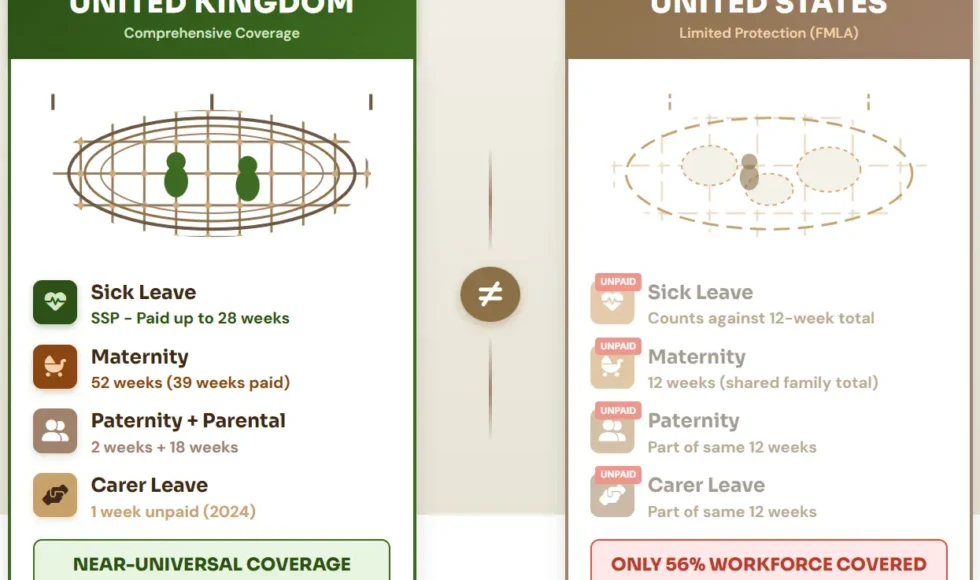
The United Kingdom has specific rights for fathers and partners that just are not part of American federal law.
UK Paternity Leave
As a father or partner you can take either one or two weeks off work from Statutory Paternity Leave, paid at £184.03 per week or 90% of average weekly earnings (whichever is lower). This is in addition to and independent of the mother’s rights to maternity.
Under Shared Parental Leave, parents can split 50 weeks of leave and 37 weeks of pay between them – flexible to accommodate families where both parents want significant time with their child or, for example, where the mother wants to return to work earlier AND hand over the rest of her maternity leave to the father.
The American Equivalent
There isn’t one, really. FMLA counts as “bonding time” with a new child but it’s the same 12 unpaid weeks that covers everything else. For example, if a dad uses two weeks for paternity leave, he has that amount less time to take off in the year through the FMLA. If he then has a medical emergency six months later, he only has 10 weeks left — not 12.
There are no federal mandates around paternity pay of any kind. The benefits are available voluntarily from employers who offer it and remain inconsistent across industries and pay levels.
What Each System Offers: The Overview
Before getting into the weeds, here’s the broad picture of how these two systems compare across common situations workers face.
| Situation | UK Protection | US FMLA |
|---|---|---|
| Sick leave | SSP – paid up to 28 weeks | Unpaid, counts against 12-week total |
| Maternity | 52 weeks leave (39 weeks paid via SMP) | 12 weeks unpaid (shared family total) |
| Paternity | 2 weeks paid | Part of same 12 weeks unpaid |
| Parental leave | 18 weeks unpaid per child | No separate entitlement |
| Carer leave | 1 week unpaid (from April 2024) | Part of same 12 weeks unpaid |
| Emergency family leave | Time Off for Dependants | Part of same 12 weeks unpaid |
| Eligibility | Near-universal for statutory minimums | ~56% of workforce covered |
The contrast becomes clear rather quickly. The UK has built separate protections for separate circumstances. America bundles the lot into one 12-week unpaid allocation that workers must ration across whatever life throws at them.
Statutory Sick Pay: Britain’s Safety Net When You’re Unwell
When British employees fall ill, Statutory Sick Pay provides a baseline of income protection. The current rate stands at £116.75 per week for the 2024/25 tax year, payable for up to 28 weeks. It’s not going to make anyone wealthy, but it means the choice between recovering properly and paying rent isn’t quite so stark.
How SSP Functions
Employees qualify if they’re classed as employed earners, have done work for their employer, and earn at least £123 per week on average before tax. The illness needs to last more than three consecutive days—what’s called a Period of Incapacity for Work—and there’s a three-day waiting period before payments begin.
SSP gets calculated daily based on normal working days, with tax and National Insurance deducted like regular wages. If you’ve received SSP within the prior eight weeks, that waiting period may not apply to fresh claims.
What America Offers Instead
Here’s where things get a bit grim for American workers. There is no federal mandate for paid sick leave in the United States. None whatsoever. Individual states and cities have enacted their own requirements in some places, but nationally speaking, roughly 25 million American workers lack access to even a single paid sick day.
FMLA does provide job protection for serious health conditions, but the leave is entirely unpaid. And because FMLA bundles all leave types together, any days taken for illness eat into the same 12-week annual pot that would cover maternity leave or caring for a sick parent.
Workers searching online for is FMLA paid leave exists often discover the disappointing answer—it does not. The law protects your job while you’re away. It doesn’t protect your income.
Maternity Rights: 52 Weeks vs 12 Weeks
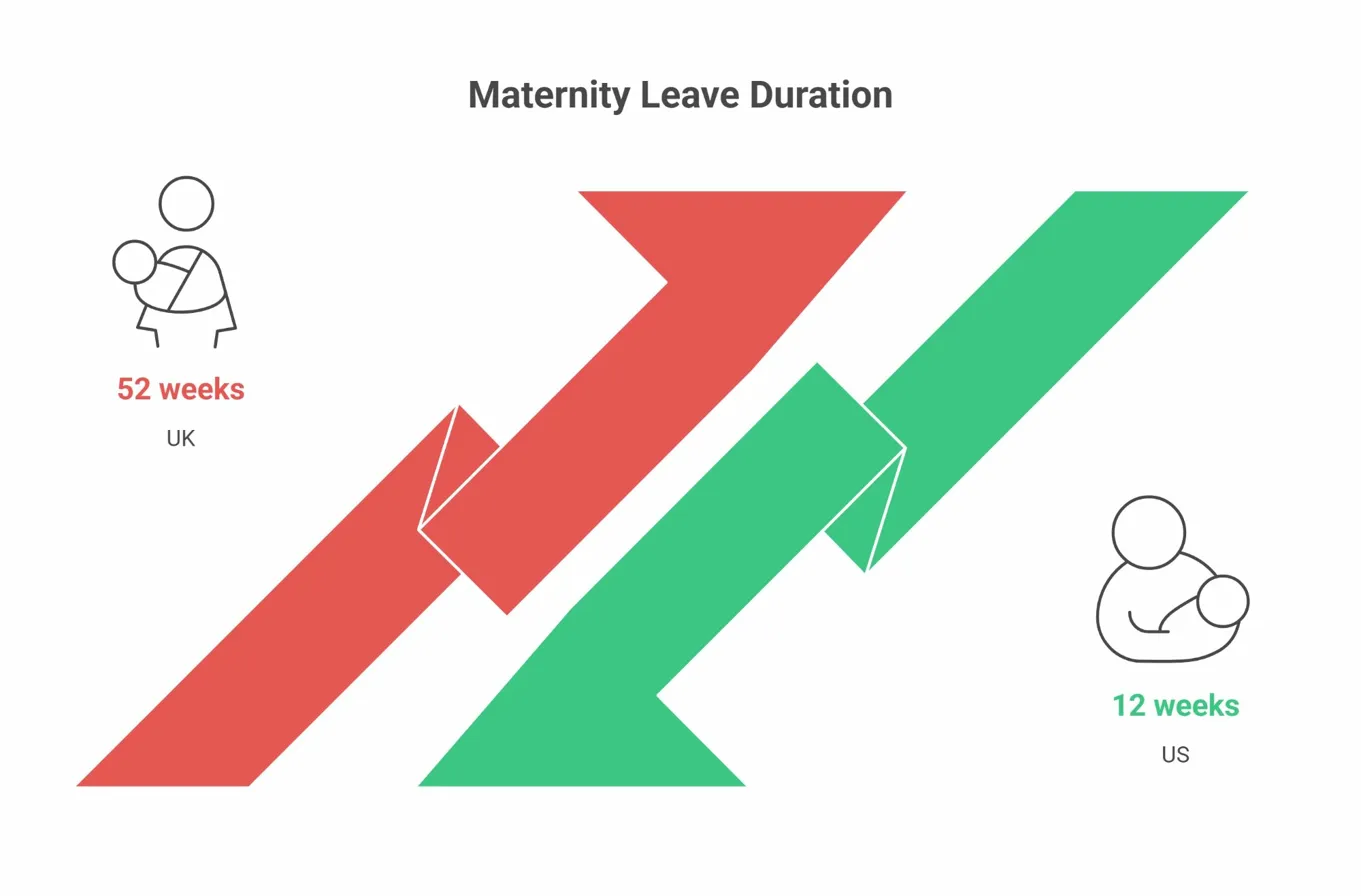
The disparity between UK and US maternity provisions is perhaps the starkest illustration of how differently these systems treat working parents.
UK Maternity Leave and Pay
British employees are entitled to up to 52 weeks of maternity leave—26 weeks of Ordinary Maternity Leave followed by 26 weeks of Additional Maternity Leave. You needn’t take the full allocation, but it’s there if wanted.
Statutory Maternity Pay covers 39 of those weeks:
First 6 weeks: 90% of average weekly earnings with no cap. If you’re on decent wages, this portion maintains most of your income.
Weeks 7-39: £184.03 per week or 90% of earnings, whichever is lower. The rate applies from April 2024.
The remaining 13 weeks of available leave are unpaid, but the option exists for those who need or want extended time with their newborn.
Eligibility requires 26 weeks of continuous employment by the 15th week before the due date, plus average earnings at or above £123 weekly. Most employees in stable positions will meet these thresholds without difficulty.
What American Mothers Receive
FMLA provides 12 weeks of unpaid, job-protected leave. That’s the total. And it’s not exclusively for maternity—it’s the same 12 weeks that covers any qualifying reason, meaning fathers wanting bonding time and mothers recovering from childbirth draw from the identical pot.
No federal law requires employers to pay anything during maternity leave. Some employers offer paid parental leave as a benefit, but this is voluntary and tends to concentrate among white-collar professional positions. Service workers, retail employees, and those in lower-wage roles frequently receive nothing beyond the unpaid FMLA protection—if they even qualify for that.
The eligibility requirements knock out a substantial portion of the workforce. You need 12 months of employment with your current employer, at least 1,250 hours worked during that period, and your employer must have 50 or more employees within 75 miles of your worksite. Roughly 44% of American workers don’t meet these criteria.
The Practical Reality
A British woman having a baby can take nearly a year away from work with 39 weeks of pay and return to her job. An American woman in comparable circumstances gets 12 weeks unpaid—if she qualifies—and must weigh every day of leave against other potential needs like illness or caring for family members.
It’s chalk and cheese, frankly.
Paternity and Shared Parental Leave
The UK has distinct provisions for fathers and partners that simply don’t exist in American federal law.
Paternity Leave in the UK
Fathers and partners can take one or two weeks of Statutory Paternity Leave, which is paid at £184.03 per week or 90% of average wages, whichever is lower. This is in addition to and not the same as the mother’s maternity leave.
Shared Parental Leave lets parents split up to 50 weeks of leave and 37 weeks of compensation. This gives families more options when both parents want to spend time with their kid or when the woman wants to go back to work sooner and the father takes over.
The American Version
There isn’t one, to be honest. FMLA covers “bonding time” with a new kid, but all other leave is unpaid for 12 weeks. If a father takes two weeks off for paternity leave, he will lose two weeks of his yearly FMLA leave. If he experiences a health issue six months later, he only has ten weeks left instead of twelve.
There is no federal law that says you have to pay paternity leave. Employers who offer it do so on their own, and coverage is still spotty across industries and income levels.
Parental Leave: 18 Weeks vs Nothing Specific
British employment law provides a separate entitlement called parental leave—distinct from maternity, paternity, or shared parental leave—that allows parents extended time for childcare purposes.
UK Parental Leave Entitlement
Under the Employment Rights Act 1996 and the Maternity and Parental Leave Regulations 1999, eligible employees receive up to 18 weeks of unpaid parental leave for each child, usable until the child turns 18. Eligibility requires one year of continuous service and parental responsibility for the child.
The leave typically gets taken in blocks of whole weeks, with a limit of four weeks per child per year unless the employer agrees otherwise. Terms and conditions of employment continue during the leave except for remuneration, and employees retain the right to return to the same or equivalent position.
US Provision
FMLA doesn’t create a separate parental leave category. Any leave for child-related reasons comes from the same 12-week annual bucket. Once those weeks are exhausted, federal law provides no additional protection for parents needing time with their children.
Carer’s Leave: The UK’s New Protection
The Carer’s Leave Act 2023, which went into effect on April 6, 2024, gave people a new right that didn’t exist in UK law before.
What the Act Says
Employees can now take up to a week off without pay every 12 months to take care of dependents. If you work three days a week, your “week” is three days long. This is the same as your typical work schedule.
This is a right from day one. There is no minimum service period. The employee’s job is still safe, and they will still be able to work.
Dependents are eligible if they need long-term care for more than three months because of illness, injury, disability under the Equality Act 2010, or old age. It’s interesting that the dependant doesn’t have to be a family member; anyone who fairly depends on the employee for care is included in the definition.
Requirements for Notice
Employees must give at least twice the amount of time they plan to be away, and for taking one day or half a day, they must give at least three days’ notice. Employees don’t have to give written notification or proof of the dependent’s condition.
If the vacation will really hurt the business, employers can put it off, but they have to suggest a new date within a month and give a written justification within seven days.
How the US Meets the Needs of Carers
FMLA allows you to take time off to care for a spouse, child, or parent with a major health problem, but it’s still the same 12 weeks of unpaid leave for all reasons. There isn’t a separate allocation for carers.
The American way makes workers make a choice. If you get sick or your child needs you, you won’t have time to take care of your aged mother. The UK system sees them as separate situations that need separate protections.
Time Off for Dependants: Emergency Leave
Sometimes life doesn’t provide advance notice. Children fall ill at school. Elderly parents have falls. Care arrangements collapse unexpectedly. UK law accounts for these situations specifically.
UK Statutory Right
Sections 57A and 57B of the Employment Rights Act 1996 provide all employees—this is another day-one right—with reasonable unpaid time off during working hours for emergencies involving dependants. Qualifying situations include:
- Illness, injury, or assault affecting a dependant
- Giving birth (for attending, not the mother herself)
- Death of a dependant
- Unexpected disruption to care arrangements
- Incidents involving a child at school
Dependants include spouses, partners, children, parents, household members excluding lodgers and tenants, or anyone else reasonably relying on the employee for assistance in emergencies.
Employees must notify employers as soon as reasonably practicable, explaining the reason and expected duration. No payment is statutorily required, though some employers offer it as a matter of policy.
The US Approach
FMLA covers serious health conditions affecting family members, but doesn’t specifically address emergency situations requiring immediate response. The 12-week allocation doesn’t distinguish between planned absences and genuine emergencies.
Some American workers have no job protection at all for family emergencies if they don’t meet FMLA eligibility requirements or if their employer has fewer than 50 employees.
The Eligibility Gap: Who Actually Gets Protected
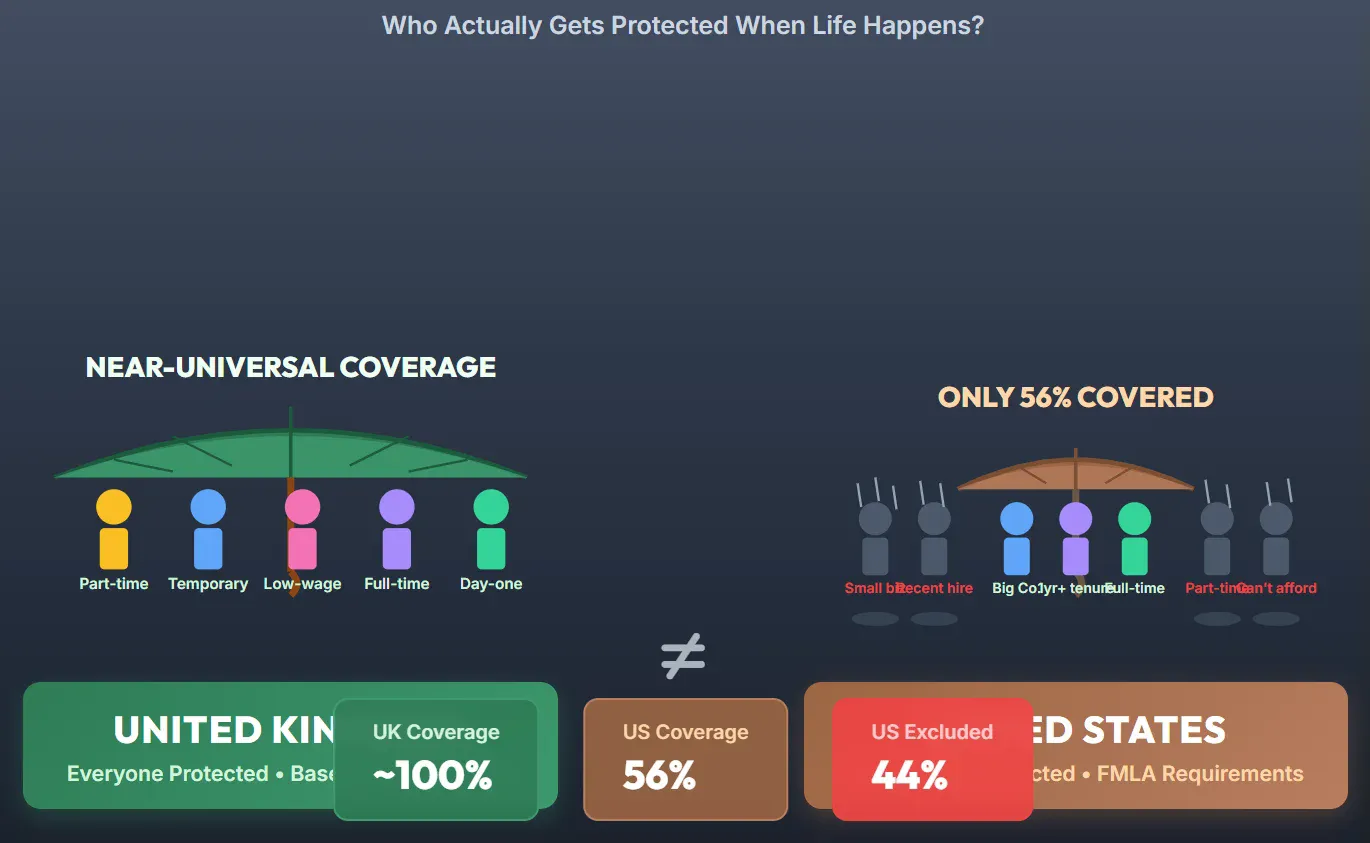
Perhaps the most significant difference between these systems isn’t the leave provisions themselves but who can actually access them.
UK Eligibility
British statutory rights apply to employed earners generally, with specific qualifying conditions varying by leave type. SSP requires earning above the Lower Earnings Limit. SMP requires 26 weeks’ service. Some rights like time off for dependants and carer’s leave are day-one entitlements.
The result is near-universal coverage for statutory minimums. Part-time workers, temporary staff, and those in lower-wage positions receive the same baseline protections as full-time permanent employees earning significantly more.
FMLA’s Coverage Holes
American workers face a gauntlet of eligibility requirements that exclude enormous portions of the workforce.
- Employer size: Only workers at employers with 50 or more employees within 75 miles qualify. Small business employees—and America has rather a lot of small businesses—have no FMLA protection.
- Service requirements: You need 12 months of employment with your current employer plus 1,250 hours worked in that period. Job-hoppers, recent hires, and part-time workers frequently don’t meet these thresholds.
- Coverage statistics: Research indicates only about 56% of American workers are actually eligible for FMLA protection. The remaining 44% have no federal job protection when life events require time away from work.
Even among those who qualify, many cannot afford to take unpaid leave. One study found 6.9% of workers who needed FMLA leave in 2018 didn’t take it because they couldn’t manage without wages.
The Pay Question: Where Systems Diverge Most Sharply
British workers often don’t fully appreciate that SSP, SMP, and Statutory Paternity Pay are genuine anomalies from an American perspective. The US federal government simply doesn’t mandate that employers pay workers during leave.
UK Statutory Pay Rates (2024/25)
| Leave Type | Rate | Duration |
|---|---|---|
| SSP | £116.75/week | Up to 28 weeks |
| SMP (first 6 weeks) | 90% of earnings | 6 weeks |
| SMP (weeks 7-39) | £184.03/week or 90% earnings | 33 weeks |
| Statutory Paternity Pay | £184.03/week or 90% earnings | 1-2 weeks |
| Shared Parental Pay | £184.03/week or 90% earnings | Up to 37 weeks |
These amounts aren’t generous by any standard, and plenty of British workers find them inadequate for maintaining their normal standard of living. Many employers top up statutory amounts as a benefit.
But the baseline exists. There’s a floor beneath which workers cannot fall.
American Statutory Pay Rates
Zero. At the federal level, the statutory pay rate for FMLA leave is nothing at all.
Some states have enacted their own paid family leave programmes—California, New York, New Jersey, and a handful of others. Some employers provide paid leave voluntarily. But federally, the law requires only that your job be held whilst you’re away. Your income during that period is your own concern.
What This Means Practically
These systems aren’t different in an academic way. When things happen in life, they change how individuals live.
A British worker who is sick can get SSP while they are recovering and then go back to work without using up protections that are designed for other things. If an American worker has the same diagnosis, they can take unpaid FMLA absence and come back with fewer weeks available if their child requires care later.
A British couple who is about to have a baby can prepare for 52 weeks of maternity leave with 39 weeks of pay. The partner can also take paternity leave, which is a separate benefit. A couple from the United States has 12 weeks of unpaid time off that they have to consider against other requirements every day.
A British worker can take carer’s leave if their elderly parent gets a long-term illness. This won’t effect their sick leave or parental leave. An American worker who takes care of a parent uses the same 12-week pot that covers their own health and their children’s.
The UK approach understands that workers go through many different kinds of life events and sets up different protections for each one. The American way of doing things recognises that these things happen, but it only gives one group of unpaid time to deal with them all. It doesn’t even give that protection to over half of the workforce.
Sometimes, British workers complain that the minimum wage is too low or that the rules for taking time off are too hard to understand. That’s fair; there’s always opportunity for growth. But the basic structure of employment protection is so different between these two countries that American workers who look across the Atlantic might question what their own system is doing.
References
- Employment Rights Act 1996: https://www.legislation.gov.uk/ukpga/1996/18/contents
- Maternity and Parental Leave etc. Regulations 1999: https://www.legislation.gov.uk/uksi/1999/3312/contents
- Carer’s Leave Act 2023: https://www.legislation.gov.uk/ukpga/2023/18/contents
- UK Government SSP Guidance: https://www.gov.uk/statutory-sick-pay
- UK Government SMP Guidance: https://www.gov.uk/maternity-pay-leave
- Family and Medical Leave Act (29 U.S.C. § 2601): https://www.dol.gov/agencies/whd/fmla
- US Department of Labor FMLA Fact Sheet: https://www.dol.gov/agencies/whd/fact-sheets/28-fmla