
The line between posting about your own business and running an unlabelled advert has never been thinner. In 2025, the Advertising Standards Authority made it clear that it no longer sees a difference — and it has the enforcement data to back that up.
The May 2025 Report That Changed the Conversation
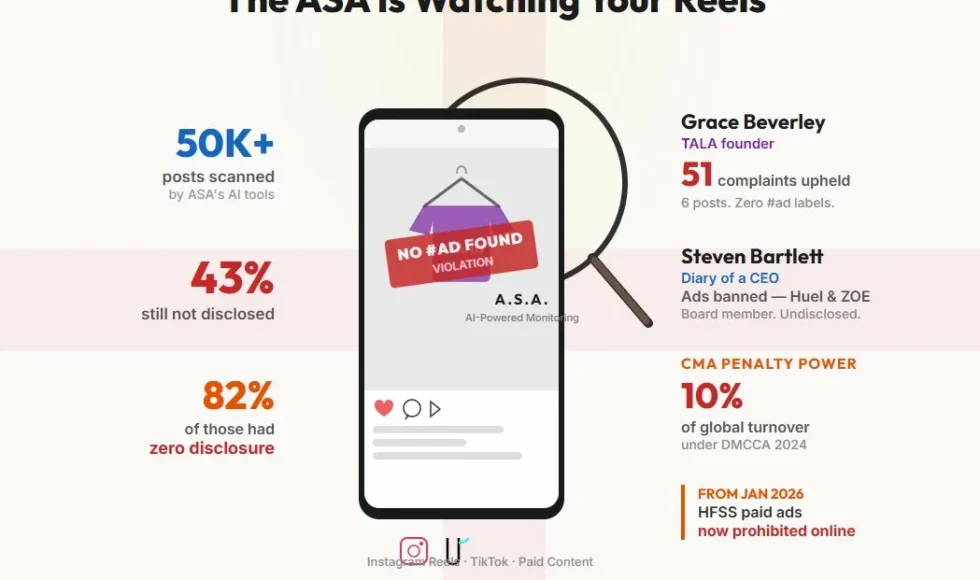
In May 2025, the ASA published findings from its second AI-driven review of influencer advertising across Instagram and TikTok. The numbers weren’t reassuring. Over 50,000 pieces of content were scanned. Roughly 57% of influencer ads were properly disclosed — an improvement from 35% back in 2021, but still well short of where the regulator expected things to be.
That means 43% of influencer ads on these platforms had either no disclosure at all or used labels like “gifted,” “affiliate,” or “pr trip” — terms the ASA and the Competition and Markets Authority have both said don’t count. Of the non-compliant content, 82% had absolutely zero disclosure. Not a vague label. Nothing.
Fashion and travel were the worst offenders. Over half of influencer ads in both sectors were either completely unlabelled or poorly labelled. The ASA responded by announcing it would apply direct sanctions to accounts that consistently fail to disclose. This isn’t advisory guidance anymore.
Grace Beverley, TALA, and the Ruling That Set a Precedent
The proof that nobody is too well-known to get caught came in May 2024. The ASA upheld 51 complaints against Grace Beverley — the founder of activewear brand TALA and a Forbes 30 Under 30 alumna — over six social media posts. Two Instagram Reels and four TikTok videos, all promoting TALA products, none labelled as ads.
TALA’s defence was straightforward: Beverley founded the brand, her followers knew it, and her language throughout the videos made the commercial connection obvious. She spoke in first person plural — “factories we literally had to beg at the door to get into” — and discussed production details no ordinary consumer would know.
The ASA disagreed. The reasoning came down to reach beyond existing followers. Instagram’s joint publishing feature and TikTok’s For You Page push content to users who don’t follow the creator. Those people had no way of knowing Beverley owned TALA unless they clicked through her profile and pieced it together. The regulator called that expecting the public to “play detective.”
Miles Lockwood, director of complaints and investigations at the ASA, called it “precedent setting.” The message was blunt: even when you own the brand, even when your audience arguably knows it, every promotional post needs a visible “#ad” or equivalent marker.
Three months later, Steven Bartlett — host of Diary of a CEO and one of the most recognised entrepreneurs in the UK — faced ASA bans on ads for health brands Huel and ZOE. Bartlett held financial interests in both companies as a board member and investor. The posts didn’t disclose that. Same principle, bigger name.
The HFSS Advertising Ban — January 2026
While the ASA was tightening screws on disclosure, a separate regulatory shift landed at the start of this year. From 5 January 2026, paid online advertising of foods and drinks classified as high in fat, sugar, or salt became prohibited under amendments to the Communications Act 2003. Television ads for HFSS products are now banned before the 9pm watershed.
The food and drink industry had already begun voluntary compliance from October 2025. Small businesses and pure brand advertising benefit from limited exemptions, but product-specific paid promotion through Instagram Reels, TikTok, or any other online channel now sits firmly outside the law for HFSS items.
For small food businesses that relied on short-form video ads to drive sales, this reshaped the entire promotional strategy overnight. Brand storytelling and organic content remain permissible, but the moment a post becomes a paid ad featuring an identifiable HFSS product, it trips the restriction.
The Bigger Enforcement Picture
The ASA itself doesn’t issue fines. It names offenders publicly, requests content removal, and can escalate to the Competition and Markets Authority. That escalation route got sharper in 2024 with the Digital Markets, Competition and Consumers Act, which gave the CMA direct enforcement powers. Penalties under the DMCCA can reach up to 10% of global turnover.
Separately, the Online Safety Act 2023 entered active enforcement in March 2025, with platforms now legally required to protect UK users from illegal content. Ofcom, the regulator behind the Act, has already fined platforms including 4chan and adult content operators, with penalties reaching £1 million in December 2025. Enforcement is expected to widen considerably through 2026.
None of this means small businesses should avoid social media. Quite the opposite — organic short-form video remains one of the most effective channels for visibility. Some smaller brands looking to gain early traction choose to kick-start your business reels with Blastup, pairing that initial momentum with consistent, genuine content over time. The regulatory issue isn’t visibility or engagement. It’s undisclosed commercial intent.
Where This Leaves UK Small Businesses
As the saying goes — forewarned is forearmed. The practical takeaways from the past twelve months of ASA and CMA activity are narrower than most commentary suggests.
If a post promotes a product or service and there’s any commercial relationship — ownership, payment, gifting, affiliate commission, equity, board membership — it needs a visible “Ad” or “#ad” label. Not buried in hashtags. Not disguised as “collab” or “partner.” Visible at the point a viewer first encounters the content.
If the product falls under HFSS restrictions, paid promotion through any online channel is now prohibited. Organic content discussing the brand is still permissible, but the line between organic and paid is exactly what the ASA is policing.
And if the business operates across platforms where user-generated content features — including review sections, comment threads, or community pages — the Online Safety Act may impose additional compliance obligations around content moderation and risk assessment.
The regulatory direction is clear. Transparency isn’t a recommendation anymore. It’s the minimum standard, and the penalties for ignoring it just got a lot more expensive.
This article is for informational purposes only and does not constitute legal advice. Regulatory requirements vary by sector and business size. Readers should consult a qualified legal professional for guidance specific to their circumstances.