
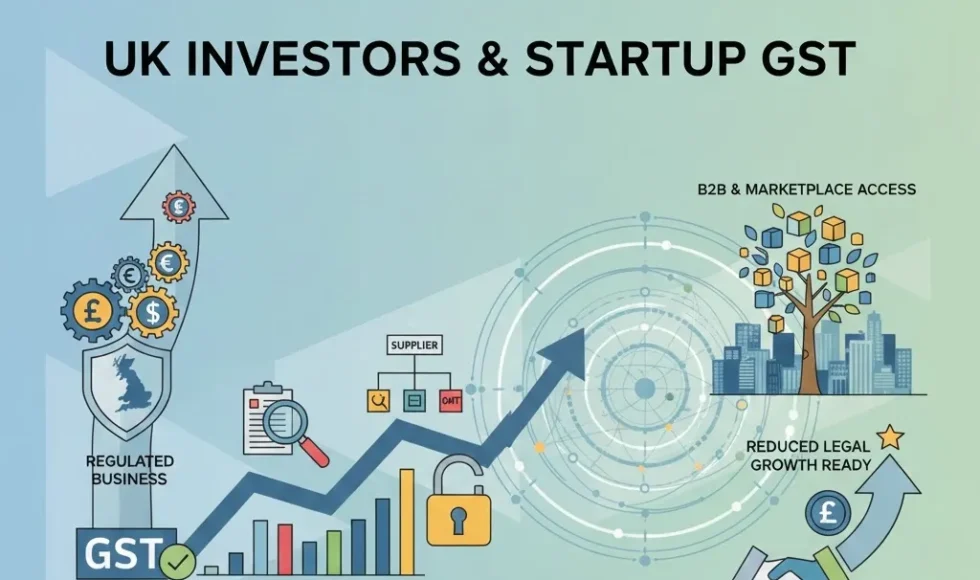
If you sit through enough investor calls, you notice a pattern. Before anyone gets excited about product demos or pitch decks, someone always asks a simple compliance question: “Have you registered for GST?” Founders roll their eyes because it feels administrative, but investors don’t ask this to tick a box. They ask because, in their world, a business that hasn’t taken care of basic tax registration is usually messy in other places too.
People in the UK react the same way when a business isn’t VAT-registered. It tells them the financial system underneath the company might not be ready for larger transactions. UK investors bring that mindset into Indian deals automatically, so the comparison isn’t theoretical — they evaluate GST the same way they evaluate VAT filings at home.
GST as Evidence, Not Formality
Here’s the part founders underestimate: GST registration gives investors verifiable data. They can see when the business started filing, what kind of activity the company is involved in, and whether the internal books match the returns. No pitch deck will ever give that level of factual clarity.
It works the same way with VAT in the UK. If a business sells above the threshold but hasn’t registered, people assume the accounting isn’t being handled properly. That doubt spills into every other aspect of diligence. In India, the equivalent doubt appears the moment a founder says, “We’ll register for GST later,” especially if the company is already earning.
For an investor, GST registration isn’t about liking government portals. It’s about knowing the business lives inside the regulated economy — where contracts, invoices, credits, and obligations can actually be checked.
Input Tax Credit Tells Them How You Operate
This is where the real evidence shows up. When a business claims Input Tax Credit (ITC), it leaves a trail of invoices, supplier filings, and reconciled figures. Investors follow that trail to see whether the company’s numbers are trustworthy.
If the ITC claims are consistent with GSTR-2B, they know the suppliers are filing their returns correctly. If nothing matches, then either the suppliers aren’t compliant or the startup’s internal records aren’t maintained properly. Both raise flags. And again, this is exactly how VAT audits work in the UK — one mismatch and the auditor wants explanations for everything.
A founder who keeps ITC clean is basically showing the investor, “Our accounting is tight, and we know our expenses line by line.” It’s a very different signal from the founder who still asks the accountant for last year’s invoices.
Revenue and Expense Checks Depend on GST Data
During due diligence, investors and auditors try to link three things:
-
Money that came in
-
Invoices raised with GST
-
The GST liability shown in returns
If all three point in the same direction, nobody complains. When they don’t, the investor believes either the numbers are inflated or the business isn’t recording everything. In the UK, people rely on VAT returns to cross-check turnover for exactly this reason. GST gives Indian founders the same accountability framework.
When founders avoid GST registration until the last moment, the early months (sometimes years) remain undocumented from a tax point of view. Investors hate that gap because it forces them to trust your spreadsheets instead of formal filings.
Why GST Registration Opens Doors Larger Firms Won’t Open Otherwise
Anyone who has tried to sign a B2B contract with a corporate client knows how it works. Before procurement checks your product, someone in finance will ask for your GST number. They need it to claim their own credits, and without it, they treat you as a fringe vendor.
This is identical to how UK companies treat non-VAT businesses. If you aren’t VAT-registered, some firms simply won’t onboard you. It doesn’t matter how good the product is — the accounting friction isn’t worth it.
This is why investors always push founders to register for GST early. They know you’ll eventually need it to work with larger customers, to operate across state lines, or to sell through marketplaces. GST sits at the centre of all those interactions. Without it, the founder ends up improvising workarounds that won’t scale.
Reducing Legal and Tax Risks for Everyone Involved
Most funding rounds fall apart because of compliance issues, not product issues. A startup with delayed GST filings, missing invoices, or unresolved notices becomes a risky bet. Investors aren’t worried about your past mistakes — they’re worried about future liabilities they will inherit.
People in the UK have seen acquisitions stall because of VAT disputes. The same thing happens with GST in India. If a company’s returns are clean and reconciled, the exit process is straightforward. If not, buyers demand price reductions, extra guarantees, or worse — they walk away.
A founder who handles GST properly shows discipline in the areas investors can’t see. It also means fewer distractions for the leadership team, because they aren’t constantly firefighting notices or mismatched returns.
Bringing It Together
Founders often think GST registration is just an administrative step. Investors treat it as something much deeper: a sign that the company keeps proper records, manages suppliers responsibly, and can back its revenue claims with actual filings. UK-based investors, in particular, interpret GST through the same mental model they use for VAT compliance. That’s why they ask about it so early.
If you’re planning to raise money — from angels, VCs, or even strategic partners — it’s much easier when the groundwork is clean. Register for GST before someone has to tell you to do it. It saves you explanations later and signals that you’re running a business built for real growth, not a hobby that scaled too quickly.